


Welcome To The Antiquarian Bible History Library
The Living Word
"The Bible is so majestically deep
that scholars could swim and never
touch the bottom, yet so
wonderfully shallow that a little child
could come and get a drink of water
without fear of drowning."
That is God's precious, holy Word.
The Word of God. Know it. Believe it. It is True.
ONE VOICE, FORY PENS THE 1,500-YEAR SYMPHONY Every Bible we craft carries a story that spans centuries and continents. Long before it was bound in fine leather, this sacred text was recorded on fragile papyrus and durable animal vellum. It moved from the blistering deserts of Africa to the grand palaces of Asia, and finally into the stone prisons of Europe. God chose about forty distinct human pens—kings, scholars, doctors, and poets—to write His message in Hebrew, Aramaic, and marketplace Greek. Over roughly 1,500 years, their diverse lives blended into one unified, unshakeable narrative. We believe a book with this kind of history deserves to be preserved beautifully. Our Bibles are built to honor this 1,500-year symphony, created to endure for generations to come. The Story Behind the Bible The master plan began in the ancient world around the time of Moses. A former prince of Egypt turned shepherd, Moses dipped his reed pen in ink to record the traditional foundation of the Torah. Writing in ancient Hebrew, the language of his people, he became the first great writer in this epic story—working in a world that stretched across Africa and Asia. Five hundred years later, the project moved deep into Asia. In the kingdom of Israel, a shepherd boy became King David. From the rugged wilderness to the grand city of Jerusalem, he poured his heart into raw, emotional songs and prayers, becoming the Bible's most famous songwriter through the Psalms. As centuries rolled on, the Author continued to select men from completely opposite worlds. A brilliant royal official named Daniel wrote from within the Babylonian empire, switching his script to Aramaic—the language that had become widely used across the ancient Near East. Meanwhile, Amos, a rugged herdsman and dresser of sycamore figs, recorded heavy prophetic warnings under the very same divine prompting. The centuries flew by, but the single, unified storyline never broke. Finally, the timeline crossed into the first century CE, and the story entered the world of Europe and the wider Mediterranean. The world had changed, and the New Testament writers used Koine Greek—the common tongue of trade and travel that allowed the message to explode worldwide. In a damp Roman prison cell, an intellectual named Paul chain-linked deep theology into letters written to young churches. A short distance away, a rough Galilean fisherman named Peter—now an apostle and eyewitness to Christ—dictated his powerful testimony. By roughly 100 CE, the Apostle John sat on the rocky island of Patmos, lifting his pen from the final, breathless vision of Revelation. The 1,500-year clock had reached its traditional conclusion. About forty different human writers—kings, doctors, fishermen, and scholars—separated by thousands of miles and generations of history, had completed their work. They spoke different languages and lived centuries apart. Most never met. Yet, when their individual scrolls were finally gathered and laid side by side, they did not clash. They formed a single, flawless library. The forty pens have finished their chapters, leaving behind a single story written by One Sovereign Author. Today, we pick up where the pens left off—binding the symphony to last for generations. One Voice. Forty Pens. 1,500 Years. One Eternal Story. Preserving History • Inspiring Faith • Connecting Generations. — Ages of Scripture 🕊️
THE SPARKS OF REFORMATION HOW THE BIBLE CHANGED THE WORLD ❖ There are books that record history. And then there are books that help change it. Few objects in human history have traveled a more remarkable path than the Bible. For centuries, biblical manuscripts were copied by hand, one page at a time. They required enormous amounts of labor, materials, and time. A beautifully illuminated manuscript might become a treasure of a monastery, a cathedral, or a wealthy household—but the world of books was still a world of scarcity. Then, in the middle of the fifteenth century, something extraordinary happened. The printed page was born. ❖ THE FIRST SPARK: GUTENBERG In Mainz, Germany, Johannes Gutenberg and his associates developed a system of printing with movable metal type that transformed the production of books in Western Europe. The Bible became their great achievement. Printed around 1454–1455, the Gutenberg Bible was the first large-format typographic Bible produced in Europe. It was printed in Latin, largely following the Vulgate tradition, and probably produced in a run of about 180 copies. The achievement was extraordinary. Instead of reproducing an entire page by hand, individual pieces of type could be arranged, printed, removed, and reused. This technology made it possible to reproduce texts in quantities that had previously been unimaginable. The Gutenberg Bible itself still carried the beauty of the manuscript world. Many copies were printed on fine paper or vellum and later decorated by hand, combining the new technology of printing with the artistic traditions of the medieval book. Fewer than fifty substantially complete copies survive today. While the Gutenberg Bible was not the first book ever printed with movable type—the technology had existed earlier in East Asia—in Western Europe it marked a decisive turning point. The age of mass printing had begun. And once words could move faster, ideas could move faster too. ❖ THE SECOND SPARK: THE RETURN TO THE SOURCES Another revolution was quietly taking shape. Across Renaissance Europe, scholars were returning to ancient Greek and Latin texts. Humanist scholars encouraged a principle that would become enormously important: go back to the original sources. One of the scholars who helped demonstrate the importance of this approach was Lorenzo Valla, whose work examined the Latin Vulgate in light of the Greek manuscript tradition. Then came Desiderius Erasmus. In 1516, Erasmus published his Greek New Testament alongside a Latin translation. His work was imperfect and hurried in places, but historically it was enormously important. For the first time, a Greek New Testament was made widely available to European scholars in printed form. The question was no longer simply: What has tradition handed down? It was increasingly: What do the earliest surviving texts actually say? The printed Greek New Testament would become an important foundation for the work of later translators and reformers. The spark was growing. ❖ THE THIRD SPARK: LUTHER In 1517, the growing tension erupted into something much larger. Martin Luther, an Augustinian monk and theology professor in Wittenberg, challenged the practice of selling indulgences and raised fundamental questions about repentance, forgiveness, and the authority of the Church. His famous Ninety-Five Theses were written in Latin as theological propositions for debate. But the printing press changed what happened next. The ideas were reproduced, translated, circulated, and discussed far beyond the academic world in which they began. What might once have remained a local theological dispute became a Europe-wide controversy. Luther's developing theology increasingly emphasized the authority of Scripture and the doctrine of justification by faith. Along with his theological arguments, Luther did something that would prove just as important: he translated the New Testament into German. Published in 1522, his German New Testament brought Scripture into the language of ordinary German readers and demonstrated the extraordinary power of the vernacular Bible. The Bible was no longer simply a text to be studied by scholars; it was becoming a book people could read in their own language. ❖ THE FOURTH SPARK: THE TRANSLATORS The movement did not belong to Luther alone. Across Europe, translators and reformers were working to bring Scripture into the languages spoken by ordinary people. In England, the desire for an English Bible had deeper roots. Centuries before the press, John Wycliffe and his followers had produced English versions of the Bible in manuscript form. Their work demonstrated that the desire to encounter Scripture in English existed long before the printing press, but printing gave that desire an entirely new power. William Tyndale became one of the most important figures in the history of the English Bible. Determined to translate Scripture into English from the original languages, Tyndale worked outside England and faced enormous opposition. His New Testament was printed in the 1520s, with the first edition appearing in 1526. Copies made their way into England. Some were seized and some were destroyed, but the words continued to circulate. Tyndale's translation would have an enormous influence on later English Bibles, including the King James Bible. The story of the English Bible was becoming a story of persistence—of translators, printers, merchants, readers, and sometimes fugitives moving Scripture from one place to another. The Bible was traveling, and so was the Reformation. ❖ THE FIRE CROSSES BORDERS The Reformation did not remain confined to Germany. Ideas and printed books moved across Europe, and Switzerland became another major center of reform. John Calvin and other reformers helped establish Geneva as an important center of Protestant scholarship and publishing. Eventually, the Geneva Bible of 1560 would become one of the most influential English Protestant Bibles of the sixteenth century. Its pages were not merely Scripture; they contained introductions, marginal notes, cross-references, maps, and other tools designed to help readers understand the text. The Bible was becoming a teaching instrument—a family book, a study book, a book carried across borders, read in homes, and capable of shaping the religious imagination of generations. ❖ THE BIBLE AND THE ENGLISH WORLD England's story would become especially complicated. Kings, queens, bishops, reformers, Catholics, and Protestants struggled over the nation's religious future. The English Bible passed through successive stages: Tyndale, Coverdale, the Great Bible, the Geneva Bible, the Bishops' Bible, and eventually the Authorized Version, commonly known as the King James Bible, published in 1611. The King James Bible did not appear from nowhere; it stood at the end of a long chain of translation and revision. Earlier English translators had already established much of the vocabulary, rhythm, and phrasing that later translators inherited. The result became one of the most influential English books ever produced. But its significance was greater than its literary beauty. The Bible had become deeply woven into the language and culture of the English-speaking world. ❖ WHEN THE BOOK ENTERED THE HOME Something fundamental had changed. The Bible was no longer only a monumental manuscript preserved behind institutional walls. Increasingly, it became a household object. Families owned Bibles, children learned from them, and names and births were recorded in their pages. Marriages were remembered, deaths were memorialized, and generations wrote their histories into the blank spaces between sacred texts. The Bible became simultaneously a religious text, a family record, a cultural artifact, and an heirloom. As printing expanded, so did the number and variety of Bibles being produced. Some were enormous, some were small enough to travel with, some were richly illustrated, and others were deliberately plain. Some were produced for scholars and clergy, while others were designed for ordinary families. The physical form changed, but the book continued to carry centuries of history with it. ❖ THE SPARK BECOMES A FLAME The effects of the printed Bible reached far beyond theology. The spread of printed texts contributed to expanding access to reading material and helped transform the intellectual culture of Europe. Printing accelerated the circulation of religious arguments, classical learning, scientific works, political ideas, and literary texts. The Reformation itself became inseparable from the new communications environment created by printing. A sermon could become a pamphlet, a theological argument could become a book, and a translation could be reproduced thousands of times. A reader in one city could encounter words written hundreds of miles away. The printed page had changed the speed of history, and Scripture was at the center of that transformation. ❖ FROM EUROPE TO THE WORLD The story did not end in the sixteenth century. Bibles continued to be translated, printed, carried, purchased, inherited, donated, hidden, transported, and preserved. They traveled with missionaries and crossed oceans with settlers and immigrants. They entered churches, schools, libraries, homes, and private collections as languages and editions multiplied. The physical Bible itself became one of the great surviving witnesses to the changing world around it. Every old Bible has a story. Its paper tells us something about technology; its type tells us something about printing; its translation tells us something about language; its illustrations tell us something about art; and its binding tells us something about craftsmanship. Its ownership inscriptions can reveal families and communities, and its wear can tell us whether it was treasured, studied, carried, or simply used. Sometimes, the scars tell the most powerful story of all. ❖ THE SPARKS WE STILL HOLD Today, centuries after Gutenberg's press began transforming the book, surviving antiquarian Bibles remain scattered across libraries, museums, churches, institutions, and private collections. They are not merely old books; they are physical witnesses. They are witnesses to the age of manuscripts, the birth of printing, the Reformation, and the struggle over language and authority. They stand as testaments to the generations of people who read, carried, marked, protected, and passed them down. That is why the history of the Bible is so fascinating. The story is not simply about what was written on its pages. It is also about what happened because those pages could finally travel farther, faster, and into more hands than ever before. A spark became a flame. The flame crossed borders. And the book that generations fought over, translated, printed, banned, defended, carried, and preserved became one of the most influential objects in human history. When we open an antiquarian Bible today, we are not simply opening an old book. We are opening a surviving piece of that journey—a witness from another age, a connection between generations, and a reminder that history is not always found in monuments or museums. Sometimes, history is sitting quietly on a shelf, waiting for someone to open the cover. Preserving History • Inspiring Faith • Connecting Generations. — Ages of Scripture🕊️
FORGED IN THE FLAMES OF TIME THE SURVIVAL OF SCRIPTURE From ancient scrolls to the printing press, the story of Scripture is also the story of preservation. Long before the Bible sat on a shelf in millions of homes, its words traveled through a world of empires, exile, persecution, handwritten manuscripts, translation, and painstaking preservation. ❖ THE ANCIENT FOUNDATIONS The Scriptures of ancient Israel were not created as a single book written at one moment. They developed across centuries, through traditions that were transmitted orally and in writing, preserved by communities, and copied by scribes. Then came catastrophe. In the sixth century BC, Babylon conquered Judah, Jerusalem was devastated, and the First Temple was destroyed. Many inhabitants were killed, displaced, or carried into exile. Yet the destruction of the kingdom did not mean the destruction of its memory. The people carried their laws, prayers, genealogies, traditions, prophetic writings, and understanding of their relationship with God with them. Scribes played a crucial role in preserving these traditions. In a world without printing presses, every manuscript had to be copied by hand. Words mattered. Letters mattered. Accuracy mattered. The goal was not to create a new Scripture with every generation, but to faithfully transmit what had been received. ❖ THE DEAD SEA SCROLLS Centuries later, some of the most extraordinary evidence of this ancient textual tradition would emerge from the caves near the Dead Sea. Beginning in the twentieth century, thousands of manuscript fragments were discovered, including some of the oldest surviving witnesses to biblical texts. The Dead Sea Scrolls revealed something remarkable. The ancient biblical tradition was not completely uniform; manuscripts contained differences in spelling, wording, and textual traditions. Yet they also demonstrated substantial continuity across centuries. For modern scholars, these manuscripts opened an extraordinary window into how biblical texts were transmitted long before the age of printing. ❖ A NEW GENERATION OF SCRIPTURE Then, in the first century AD, a new movement emerged. The followers of Jesus of Nazareth proclaimed that he had been crucified and had risen from the dead. At first, the Christian message traveled primarily through living witnesses, preaching, and oral teaching. But the movement spread rapidly throughout the Roman world. Letters were written to Christian communities. Accounts of Jesus were eventually committed to writing. These documents were copied, carried across the empire, read aloud, and shared with other communities. There was no completed New Testament sitting on a table. There were individual letters, Gospel accounts, and other Christian writings circulating among different communities. Because everything was copied by hand, differences inevitably appeared. A word could be omitted, a line could be repeated, a spelling could change, or a difficult phrase could be clarified by a copyist. These differences are known as textual variants. Rather than making the manuscript tradition useless, the existence of thousands of surviving manuscripts and ancient translations gives scholars something extraordinarily valuable: multiple witnesses that can be compared. ❖ WHICH WRITINGS BELONGED TO SCRIPTURE? Another question gradually emerged: which Christian writings should be regarded as authoritative Scripture? There was no single meeting where someone simply invented the New Testament. Recognition developed over generations. Christians considered factors such as a writing's connection to an apostle or apostolic witness, its consistency with the faith already received, its use among Christian communities, and its history of being read in worship. Some writings were widely accepted early, while others were disputed. Some respected Christian writings, such as 1 Clement, the Didache, and The Shepherd of Hermas, were valued by certain communities but ultimately were not included in the New Testament. Other writings appeared later and presented alternative accounts or teachings about Jesus. Modern scholars examine these works individually, considering their date, authorship, language, theology, manuscript evidence, and historical setting. By the fourth century, the boundaries of the New Testament were becoming increasingly clear. In 367 AD, Athanasius of Alexandria listed the same twenty-seven books that make up the New Testament today. That does not mean Athanasius single-handedly created the canon; his list reflects a much longer process of recognition that had already been underway for centuries. Regional councils later affirmed collections corresponding to the same twenty-seven-book New Testament. The library had been sifted. ❖ THE CODEX REVOLUTION But Scripture was about to undergo another transformation—not in its message, but in its physical form. For centuries, texts were commonly written on scrolls. Then the codex emerged: individual leaves bound along one edge to form a book. The codex was not invented specifically for Christianity, but Christians adopted it extensively. It offered enormous advantages: pages could be turned, passages could be located more easily, multiple writings could be gathered together, and a large collection of Scripture could occupy a single bound volume rather than numerous scrolls. The fourth-century Codex Sinaiticus and Codex Vaticanus demonstrate just how sophisticated Christian book production had become. The Bible was no longer simply a collection of separate scrolls; it was increasingly becoming a book. ❖ FROM LATIN TO ENGLISH As Christianity spread through Western Europe, Latin became the dominant language of scholarship and worship. But ordinary people spoke other languages. In England, this eventually produced a powerful question: could Scripture be made available in the language of the people? In the late fourteenth century, John Wycliffe and his followers became associated with English translations based primarily on the Latin Vulgate. The translations were handwritten, but they circulated despite growing opposition. Wycliffe died in 1384, yet his influence continued. In 1428, decades after his death, his remains were exhumed and burned following his condemnation. But destroying the remains of a man could not destroy the ideas he had helped spread. Then came an invention that changed everything. ❖ THE PRINTING PRESS In the mid-fifteenth century, Johannes Gutenberg and his collaborators helped establish practical movable-type printing in Europe. Books could now be reproduced far more rapidly than handwritten manuscripts. The Gutenberg Bible demonstrated the extraordinary potential of the new technology. But printing alone did not create the English Reformation. That required translators who were willing to work directly with the ancient biblical languages. ❖ WILLIAM TYNDALE William Tyndale believed ordinary English people should be able to read Scripture in their own language. Unlike Wycliffe's earlier English translations, Tyndale worked directly with Greek and Hebrew. His New Testament began reaching English readers in the 1520s. The first surviving edition is associated with 1525–1526, printed on the European continent and transported into England. Copies could be hidden and smuggled, and authorities attempted to suppress them. But the printing press had changed the equation: destroy one copy, and another could be produced. Tyndale was eventually arrested near Brussels in 1535 and executed in 1536. His translation, however, survived. His English phrasing profoundly influenced later translations, including the Matthew Bible, the Great Bible, the Geneva Bible, and ultimately the King James Bible. ❖ THE ENGLISH BIBLE ENTERS THE MAINSTREAM After Tyndale's death, the English Bible continued its remarkable journey. Myles Coverdale incorporated Tyndale's work into the first complete printed English Bible in 1535. The Great Bible followed in 1539 and was authorized for use in England. Then came the Geneva Bible, first published in complete form in 1560. Portable, heavily annotated, and divided into numbered verses, the Geneva Bible became enormously influential among English Protestants. By the beginning of the seventeenth century, England possessed several competing English Bible traditions. Then a new king took the throne. ❖ THE KING JAMES BIBLE James VI of Scotland became James I of England in 1603. At the Hampton Court Conference in 1604, plans developed for a new English Bible translation. A large group of scholars worked in committees, consulting Hebrew and Greek sources while also building upon generations of earlier English translation: Tyndale, Coverdale, Matthew, the Great Bible, the Geneva Bible, the Bishops' Bible, and others. The 1611 Authorized Version, later known as the King James Bible, was finally published. It did not immediately replace every competing English Bible, but over time it became one of the most influential English texts in history. And its earliest editions contain fascinating evidence of the realities of early printing. One famous example concerns Ruth 3:15. Early copies of the 1611 edition contain the reading “he went into the city,” while later copies contain “she went into the city.” Collectors have traditionally referred to these as the “He” Bible and “She” Bible. The difference is a small example of something much larger: even printed Bibles were physical products created by human hands. Typesetters made decisions, printers corrected pages, errors occurred, editions changed, and every surviving copy became a piece of history. ❖ THE BIBLE AS AN ARTIFACT This is why an antiquarian Bible is more than an old book. Its paper tells a story. Its ink tells a story. Its typography tells a story. Its binding tells a story. Annotations, ownership inscriptions, repairs, wear, and even imperfections can reveal something about the people who handled it before us. An authentic historical Bible is a physical witness to the world through which it traveled. It represents generations of scribes, translators, printers, scholars, readers, collectors, and caretakers. ❖ FROM THE DESERT TO YOUR HANDS The story of Scripture is therefore not simply the story of how one book survived. It is the story of transmission. Ancient communities preserved their traditions. Scribes copied manuscripts. Exiles carried their memories. Christian communities preserved letters and Gospel accounts. Generations debated and recognized the writings that became the New Testament. The codex transformed the physical book. Medieval scribes preserved manuscripts. Wycliffe and Tyndale helped bring Scripture into English. Gutenberg transformed the economics of printing. The Geneva scholars created a revolutionary English study Bible. And the King James translators inherited centuries of work and produced a Bible that would profoundly influence the English-speaking world. From ancient scrolls to manuscripts, to codices, to printing presses, and finally to the King James Bible, these words traveled through centuries of human hands—and they continue traveling today. That is why antiquarian Bibles matter. They allow us to hold history, study history, preserve history, and pass it forward. We are not simply looking at old books. We are looking at surviving witnesses to a journey that spans thousands of years. Preserving History • Inspiring Faith • Connecting Generations. — Ages of Scripture🕊️
THE FORBIDDEN WORD HOW THE ENGLISH BIBLE AND THE REFORMATION CHANGED HISTORY ❖ For centuries, the Bible traveled through history in languages, manuscripts, and the hands of generations. But in medieval England, one question carried enormous consequences: Could ordinary English-speaking people read and hear Scripture in their own language? The answer would eventually reshape English Christianity, influence the English language, and help create one of the most famous books in history. ❖ THE FIRST ENGLISH SCRIPTURE In fourteenth-century England, Scripture was overwhelmingly encountered through the Latin tradition of Western Christianity. John Wycliffe, an Oxford-trained theologian, became associated with a movement that emphasized the authority of Scripture. During the 1380s, English biblical translations associated with Wycliffe and his followers began circulating in manuscript form. The Wycliffite Bible was translated from the Latin Vulgate rather than directly from Hebrew and Greek. And every copy had to be written by hand. There was no printing press. No mass production. No bookstore filled with identical Bibles. Every manuscript required enormous labor. Wycliffe died in 1384, but his influence continued. His teachings were condemned after his death, and in 1428 his remains were exhumed and burned. The authorities could destroy his body. They could not destroy the manuscripts or the ideas that had already spread. ❖ THE PRESS THAT CHANGED EVERYTHING Then Europe experienced a revolution. In the fifteenth century, Johann Gutenberg and his associates developed a highly effective European system of movable metal type. Printing did not originate with Gutenberg—earlier printing technologies had existed in East Asia—but his methods transformed European book production. Around the 1450s, the Gutenberg Bible demonstrated what this new technology could accomplish. A biblical text could now be reproduced repeatedly without every copy being handwritten from beginning to end. The economics of information had changed. But a printed Latin Bible was still a Latin Bible. The next revolution would have to be linguistic. ❖ BACK TO THE ORIGINAL LANGUAGES During the Renaissance, humanist scholars increasingly called for a return to the ancient sources. For biblical scholarship, this meant examining Hebrew and Greek rather than relying exclusively upon later translations. In 1516, Desiderius Erasmus published a Greek New Testament alongside his revised Latin translation. His edition was imperfect and based on a limited collection of Greek manuscripts. But its importance was enormous. Scholars could now examine a printed Greek New Testament and compare it directly with the Latin tradition. The Reformation soon demonstrated the power of this scholarship. Martin Luther's German New Testament appeared in 1522. Scripture in the language of ordinary people was becoming a powerful force. England was waiting for its own translator. ❖ WILLIAM TYNDALE That translator was William Tyndale. Tyndale believed that ordinary English people should be able to encounter Scripture directly. He studied the biblical languages and left England when it became clear that his project could not safely be completed there. On the European continent, he translated the New Testament from Greek and began working from Hebrew for the Old Testament. His first printed English New Testament appeared in the 1520s, with the 1526 edition recognized as the first English New Testament translated from Greek and printed in substantial numbers. Copies were transported secretly into England. Some were hidden among cargo. Authorities seized and burned copies. But printing created a problem censorship could not easily solve: Destroy one copy, and another could be printed. Tyndale's translation became part of the religious conflict of the Reformation. His language was clear, memorable, and enormously influential. He was eventually arrested in the Low Countries, imprisoned, condemned for heresy, and executed in 1536. He did not live to see the full impact of his work. But his words survived. A substantial amount of the language that later appeared in the King James Bible ultimately traces its roots to Tyndale. ❖ THE BIBLE ENTERS ENGLAND Tyndale had not completed the entire Bible. Others carried the work forward. Myles Coverdale produced the first complete printed English Bible in 1535, drawing upon Tyndale's work and other sources. In 1537, John Rogers published the Matthew Bible under the name “Thomas Matthew,” preserving much of Tyndale's translation. Then came the Great Bible. Beginning in 1539, it became the first English Bible officially authorized for public use in the churches of England. Large copies were placed in churches so Scripture could be heard by congregations. The transformation was extraordinary. The English Bible had moved from forbidden manuscripts toward public worship. But the political situation could change again. ❖ MARY I AND THE EXILES In 1553, Edward VI died and Mary I came to the throne. England moved back toward Roman Catholicism. Protestants were imprisoned, exiled, and executed. Among those killed was John Rogers, the man associated with the Matthew Bible. Many Protestant reformers fled across Europe. Some eventually gathered in Geneva, Switzerland. And exile produced one of the most influential English Bibles of the sixteenth century. ❖ THE GENEVA BIBLE The Geneva New Testament appeared in 1557. The complete Geneva Bible followed in 1560. It was portable, readable, heavily annotated, and designed not simply to be heard in church but studied by individual readers and families. It contained numbered verses, extensive marginal notes, cross-references, and other study material. Its influence became enormous. The Geneva Bible became especially popular among English Protestants and Puritans and eventually crossed the Atlantic with English settlers. But its marginal notes could also be politically uncomfortable. Some challenged tyranny and discussed the limits of political authority. That would matter greatly when a new king arrived. ❖ KING JAMES AND THE 1611 BIBLE In 1603, Elizabeth I died. James VI of Scotland became James I of England. The English-speaking world already had competing Bible traditions. The Church of England had the Bishops' Bible. Protestants favored the Geneva Bible. Catholics had the Douay-Rheims tradition. In 1604, the Hampton Court Conference helped lead to the proposal for a new English Bible. The project involved roughly fifty scholars working in companies at Oxford, Cambridge, and Westminster. They examined Hebrew and Greek. They compared earlier English translations. They revised one another's work. And they inherited an enormous translation tradition. Tyndale. Coverdale. Matthew. The Great Bible. Geneva. The Bishops' Bible. The Rheims New Testament. The King James translators did not begin with a blank page. They built upon generations of earlier work. In 1611, the Authorized Version was published. James had authorized and supported the project, but he did not personally translate the Bible. The work belonged to the scholars. And the famous translation did not immediately become the undisputed English Bible. The Geneva Bible remained popular for decades. The King James tradition gained dominance gradually through church use, printing, institutional support, and literary influence. ❖ THE FAMOUS 1611 “HE” BIBLE The physical history of the first edition is fascinating. In Ruth 3:15, some early copies contain the reading: “he went into the citie.” Others contain: “she went into the citie.” Collectors traditionally refer to these as the “He” and “She” Bibles. The difference reflects the realities of early printing. Pages were produced with hand-set metal type, and corrections could occur during production. This reminds us that a first edition Bible is not simply a collection of words. It is a physical artifact. Paper. Ink. Type. Binding. Corrections. Wear. Ownership marks. Every surviving copy can preserve evidence of the world in which it was produced. ❖ THE 1611 MYTH AND THE LIVING TRADITION There is another important distinction. The King James Bible of today is not necessarily the physical text of the 1611 first edition. The KJV became a continuing publishing tradition. Spelling changed. Punctuation changed. Typography changed. Errors were corrected. Later editions standardized the text. In 1769, Benjamin Blayney produced a highly influential Oxford revision whose conventions helped establish the form of the KJV familiar to many modern readers. So when we say “the 1611 King James Bible,” we must distinguish between the original historical artifact and the much larger KJV tradition that developed afterward. That distinction is especially important for collectors. A genuine 1611 folio is a four-century-old physical witness. A modern KJV is part of a living publishing tradition. They are connected. But they are not the same object. ❖ THE BIBLE CROSSES THE ATLANTIC The English Bible eventually crossed the ocean. In 1663, John Eliot produced a complete Bible in the Massachusett language in New England—the first complete Bible printed in British North America. More than a century later, the American Revolution disrupted the supply of books from Britain. Bibles became difficult to obtain. Philadelphia printer Robert Aitken responded by producing an English New Testament in 1777 and a complete English Bible in 1782. Aitken's Bible became famous because the Continental Congress formally recommended his edition for use by the inhabitants of the United States. It is important, however, not to turn that into something it was not. Congress did not establish an official national Bible or national religion. The recommendation was connected to the practical shortage of imported Bibles during the Revolutionary period. Aitken's Bible nevertheless became an extraordinary artifact of early American printing. And the story continued. In 1808, Aitken's daughter, Jane Aitken, printed an English Bible in Philadelphia. She is widely recognized as the first woman in America known to have printed a Bible. ❖ THE FAMILY BIBLE During the nineteenth century, the Bible increasingly became a household object. Large family Bibles could contain illustrations, maps, genealogies, and pages where families recorded births, marriages, and deaths. The Bible was no longer simply something heard in church. It became a repository of family memory. An heirloom. A record passed from one generation to another. For today's antiquarian collector, these details can be just as fascinating as the printed biblical text. A family Bible can preserve genealogy. Handwriting. Migration. Ownership. Religious practice. And evidence of everyday life. ❖ THE BOOKS THAT DISAPPEARED Then there is another change many modern readers do not realize. Open an early English Protestant Bible and you may find a section between the Old and New Testaments containing books commonly called the Apocrypha. Tobit. Judith. Wisdom. Sirach. Baruch. First and Second Maccabees. Along with additional material associated with Esther and Daniel. These writings were included in major English Protestant Bible traditions, including the Great Bible, Geneva Bible, Bishops' Bible, and the original 1611 King James Bible. They were generally distinguished from the canonical books rather than simply treated as identical in authority. Over time, however, many Protestant publishers stopped including them. The change was gradual. Theological convictions played a role. Publishing economics played a role. Bible societies played a role. Smaller, cheaper editions were easier to produce and distribute without the additional material. The books did not vanish from Christianity. Roman Catholic and Eastern Christian traditions continued to preserve their own collections of these writings, and some Protestant and Anglican editions continued to print them. What changed was the typical physical form of the Protestant Bible. The modern 66-book Bible represents a later publishing convention. ❖ THE MODERN TRANSLATION REVOLUTION By the nineteenth century, another problem had emerged. English itself had changed. The language of 1611 was no longer the everyday language of later generations. At the same time, biblical scholarship was advancing. Scholars gained access to older manuscripts and developed increasingly sophisticated methods of textual criticism. Manuscripts such as Codex Sinaiticus and Codex Vaticanus became important evidence in the study of the Greek New Testament. The goal of textual criticism was not simply to rewrite Scripture. It was to compare surviving evidence and determine, as carefully as possible, the earliest recoverable wording of ancient texts. The English Revised Version appeared in 1881–1885. The American Standard Version followed in 1901. The Revised Standard Version appeared in the twentieth century. Then came translations such as the NASB, NIV, NKJV, and ESV. They differed in philosophy. Some emphasized close attention to the structure of Hebrew and Greek. Others emphasized communicating meaning naturally in modern English. But all were wrestling with the same fundamental challenge: How do you faithfully communicate an ancient text to a new generation? ❖ THE ENGLISH BIBLE BECAME A FAMILY TREE The English Bible is therefore not one isolated translation. It is a family tree. Wycliffe. Tyndale. Coverdale. Matthew. The Great Bible. Geneva. The Bishops' Bible. King James. Revised Version. ASV. RSV. And the many modern translations that followed. Each generation inherited something from the one before it. And each generation faced new questions of language, scholarship, printing, and readership. ❖ THE BIBLE IN YOUR HAND That brings us back to the antiquarian Bible. When you hold an old Bible, you are holding more than an old religious book. You may be holding evidence of a particular moment in history. The paper can tell us about manufacturing. The type can reveal the technology of printing. The binding can reveal how the book was used. Handwritten inscriptions can reveal ownership. Family records can connect generations. Corrections can reveal the realities of printing. And the physical arrangement of the books can reveal how Christians understood Scripture at a particular time. A genuine 1611 folio tells one story. A Geneva Bible tells another. An early American Bible tells another. A nineteenth-century family Bible tells another. And a modern translation tells us something about our own generation. ❖ THE WORD SURVIVED BY BEING CARRIED FORWARD That may be the most remarkable part of the entire journey. The story was never simply about one edition. It was about transmission. Manuscripts were copied. Translations were revised. Books were printed. Readers carried them across borders. Families passed them to children. Printers reproduced them. Scholars compared them. And generation after generation opened the pages. From handwritten English manuscripts... to Gutenberg's press... to Tyndale's New Testament... to the Geneva Bible... to the 1611 Authorized Version... to American family Bibles... to the modern translations on bookshelves today... the Bible continued moving through history. And that is why antiquarian Bibles matter. They are physical witnesses to a journey that spans centuries. They allow us to hold history. To study history. To preserve history. And to pass it forward. Because the Bible sitting on your shelf did not simply appear there. It arrived through the hands of generations. Preserving History • Inspiring Faith • Connecting Generations. — Ages of Scripture 🕊️
THE TYPOGRAPHY OF THE 1611 FOLIO UNLOCKING THE VAULT The Multi-Printer World Behind the First King James Bible To the modern reader, the phrase “1611 King James Bible” may sound like a single, perfectly uniform book. To the antiquarian collector, it is anything but. The first edition of the King James Bible is a fascinating bibliographical world of different readings, corrected sheets, typographical variations, and printing complications. And among the most famous distinctions are two forms that collectors and bibliographers have come to know as the Great “He” Bible and Great “She” Bible. Their names come from a single line in the Book of Ruth. Ruth 3:15. In one form, the verse reads: “and he went into the citie.” In another: “and she went into the citie.” One tiny pronoun. Two different readings. And one enormous clue into the physical history of the first King James Bible. But to understand why that little word matters, we have to step inside the printing house of 1611. We have to look beyond the famous title page. Beyond the royal name. Beyond the year. And into the world of paper, ink, metal type, compositors, corrections, sheets, issues, and states. Because the first King James Bible was not simply written. It was manufactured. And the manufacturing process left fingerprints. ❖ THE HEBREW PARADOX The story becomes even more interesting when we look at the Hebrew behind Ruth 3:15. The Hebrew wording contains a masculine verbal form that can account for the reading: “he went.” At the same time, the surrounding narrative strongly identifies Ruth as the person returning to the city. So the problem is not quite as simple as saying: “A printer accidentally typed the wrong word.” There is a genuine textual and grammatical question here. And because the original manuscript submitted by the translators to the printer no longer survives, we cannot establish with absolute certainty exactly what the translators themselves intended at that moment. That uncertainty is part of what makes the passage so fascinating. The “He” reading became a historical fingerprint. A single pronoun could help scholars identify the state of a particular copy. And that is a perfect example of how antiquarian bibliography works. Sometimes the smallest detail tells the biggest story. ❖ THE GREAT “HE” BIBLE The earliest form is popularly known as the Great “He” Bible. In Ruth 3:15, it reads: “and he went into the citie.” The “He” reading is generally regarded as belonging to the earlier issue of the first edition. But here is where collectors need to be careful. You cannot authenticate a supposed 1611 Bible simply by opening it to Ruth 3:15. The first edition contains numerous other typographical and bibliographical variations. A serious examination must consider the entire physical fingerprint of the book. The title page. The signatures. The pagination. The typography. The textual readings. The paper. The presence or absence of leaves. And the relationship between individual sheets. The “He” reading is important. But it is only one piece of the puzzle. ❖ THE GREAT “SHE” BIBLE Then comes the later form: The Great “She” Bible. Here Ruth 3:15 reads: “and she went into the citie.” This reading is associated with the later issue of the first edition in many standard bibliographical descriptions. But even that description needs qualification. Individual surviving copies can contain sheets produced at different stages. Some earlier sheets could be retained and incorporated into later production. That means one physical copy may preserve evidence from more than one stage of the printing process. And this teaches us an important lesson: A date printed on a title page does not necessarily tell us when every sheet in the book was printed. Early printing was not a modern factory assembly line. It was a complicated, flexible process. Printers reused material. Sheets could be corrected. Forms could be altered. Existing stock could be incorporated into later production. And copies could therefore develop individual bibliographical histories. The “He” and “She” Bibles are famous because they make that history visible. ❖ ENTER ROBERT BARKER Now we come to the men who physically produced the book. The King James Bible was printed under the authority of: Robert Barker, the King's Printer. Barker held the royal patent for printing Bibles and had enormous responsibility for producing this monumental work. But there is another important point. The Bible was not produced by one solitary printer working alone at one press. A project of this size required a much larger commercial operation. Barker worked with other printing partners, including Bonham Norton and John Bill. The first King James Bible therefore emerged from a complicated early-modern printing enterprise. This matters because popular imagination sometimes gives us a misleading picture. We imagine: One printer. One press. One manuscript. One perfectly controlled production. That is not what happened. The reality was far more complicated. ❖ THE WORLD OF HAND-SET TYPE Every page began with individual pieces of metal type. Think about that for a moment. Every letter. Every punctuation mark. Every space. Every word. Every line. All had to be physically assembled. Compositors selected pieces of type and arranged them into lines. Those lines were assembled into pages. The pages were locked together inside a forme. Ink was applied. Paper was positioned. Pressure was applied. And the impression was made. Then the sheet had to be dried, folded, gathered, and eventually bound. There was no digital file. No automatic spell-checker. No keyboard. No copy-and-paste. No computer screen showing the finished page. The physical page was the product of hundreds of individual decisions. And that meant mistakes could happen. A letter could be misplaced. A word could be omitted. A line could be repeated. A correction could be introduced. And once production was underway, the corrected form might appear in later sheets while earlier impressions remained in circulation. That is why early printed books are so fascinating. Their imperfections can become evidence. The mistakes are not merely defects. They are fingerprints. ❖ THE 351-ERROR FINGERPRINT Modern scholarship has made it possible to study those fingerprints in extraordinary detail. David Norton, in his work on the textual history of the King James Bible, provides an important framework for understanding the first edition and its corrections. Descriptions of Norton's work commonly identify approximately 351 printer's errors associated with the first-edition “He” Bible. One frequently cited example occurs in Genesis 10:16, where “Emorite” appears where “Amorite” would be expected. That might seem like a tiny detail. But to the bibliographer, it can be enormously valuable. Because the presence or absence of particular readings can help establish where a particular sheet belongs in the production history. The Bible therefore becomes something like a forensic document. A word here. A correction there. A different spelling somewhere else. Together, those details can reveal the sequence in which the pages were produced. ❖ THE BIBLE AS A PRINTING RECORD This is one of the most fascinating things about the 1611 folio. The book does not merely preserve Scripture. It also preserves evidence about the people who made the book. The compositors. The printers. The correctors. The publishers. The binders. And eventually the owners who handled it for generations. Every surviving sheet is a physical witness. And sometimes those witnesses disagree. That disagreement is not necessarily a problem. In fact, it can be exactly what makes the copy valuable to scholarship. When scholars compare surviving copies, they can begin reconstructing what happened inside the printing house. Which forms were printed first? Which were corrected? Which sheets were replaced? Which were reused? Which copies contain earlier states? Which contain later states? The book itself becomes the evidence. ❖ THE FIRST EDITION WAS NOT A SINGLE PERFECT OBJECT This is one of the biggest misconceptions surrounding the phrase: “1611 King James Bible.” People often imagine there was one standardized object that came off the press in exactly the same form every time. But early printing did not work that way. The first edition existed within a production process. Sheets could differ. Corrections could be introduced. Printing could continue while changes were being made. Different copies could therefore contain different combinations of readings. That is why the antiquarian collector must learn to think differently. Instead of asking: “Is this a 1611?” the better question is: “What exactly is this copy?” ❖ THE ANTIQUARIAN CHECKLIST When examining a supposed first-edition King James Bible, collectors and bibliographers may ask: Which printing or issue does the copy represent? Does Ruth 3:15 read “he” or “she”? Which textual variants appear elsewhere? Which title page is present? Are the leaves original? Are any leaves supplied from another copy? Are there missing pages? Are there repairs? Are the sheets from the same production stage? What is the pagination? What are the signatures? What does the typography reveal? What is the condition? Has the book been rebound? Has it been restored? What is the provenance? And how does the copy compare with established bibliographical descriptions? That is a completely different approach from simply looking for the date: 1611. The date is only the beginning. The physical book tells the rest of the story. This is where antiquarian Bible collecting becomes almost detective work. Imagine opening an old folio. You notice the massive dimensions. The black-letter typography. The thick paper. The old binding. Perhaps handwritten ownership inscriptions appear on the endpapers. Maybe there are repairs. Maybe there are wormholes. Maybe there is staining from centuries of use. Then you turn to Ruth. You find: “and he went into the citie.” You have discovered one important clue. But the investigation has only begun. You begin comparing other readings. You examine the title page. You study the signatures. You check the pagination. You look for missing leaves. You examine the physical structure. You compare the evidence against established bibliographical references. Suddenly the Bible is no longer simply an old book. It is a historical artifact. A surviving witness to a four-hundred-year-old production process. ❖ THE HUMAN SIDE OF THE BOOK And there is another dimension that should never be forgotten. Every sheet represents human labor. Someone selected the type. Someone assembled the lines. Someone checked the form. Someone inked the press. Someone handled the paper. Someone folded the sheets. Someone gathered the quires. Someone eventually bound the book. And after the printers were finished, other human beings continued the story. A person bought the Bible. Someone carried it home. Someone read it. Someone marked it. Someone repaired it. Someone passed it to a child. Someone inherited it. Someone eventually sold it. And somehow, four centuries later, the physical object still exists. That is remarkable. The Bible survived not merely because it was printed. It survived because people kept using it. ❖ FROM SACRED TEXT TO ANTIQUARIAN ARTIFACT There is a temptation when studying a famous Bible to focus entirely on the religious content. But an antiquarian Bible tells several stories at once. It tells a theological story. A linguistic story. A political story. A printing story. A technological story. A social story. And a family story. The paper tells us about manufacturing. The type tells us about printing technology. The binding tells us about bookmaking. The marginal notes tell us about readers. Ownership inscriptions tell us about families. Wear tells us about use. Repairs tell us about preservation. And textual variants tell us about production. The physical Bible becomes a historical witness. ❖ THE GREAT IRONY And perhaps the most fascinating irony is this: The very mistakes that early printers wanted to eliminate can now help us understand how the Bible was produced. A wrong letter. A changed word. A corrected sheet. A substituted page. A variation between copies. What looked like imperfection to the printer can become priceless evidence to the historian. The error becomes a fingerprint. The fingerprint becomes a clue. And the clue helps reconstruct the history of the book. ❖ WHAT DOES “FIRST EDITION” REALLY MEAN? So when we say: “First edition of the King James Bible,” we have to be precise. We are talking about a bibliographical category. Not simply a date. Not simply a title page. Not simply the famous phrase: Authorized Version. And not simply any old Bible printed with the year 1611. The first edition is a world of production states, issues, corrected sheets, textual variants, and surviving copies. That is why serious collectors rely upon bibliographical scholarship rather than folklore. The “He Bible” is real. The “She Bible” is real. But the story is much bigger than the pronoun. ❖ THE BOOK ON YOUR SHELF And this brings us back to the modern collector. Maybe you inherited an old Bible. Maybe you found one in an estate sale. Maybe it has a beautiful old binding. Maybe the title page says: 1611. Maybe somebody told you: “That is a King James original.” Before you celebrate... Stop. Look closer. What exactly do you have? Is it genuinely from 1611? Is it a later edition? Is it a facsimile? Is it a rebound copy? Are the leaves complete? Are the title pages original? Are there mixed sheets? Does the typography fit the period? What do the textual variants reveal? And perhaps most importantly: Can the copy be matched to a recognized bibliographical description? Because the difference between an old Bible and a genuine first-edition King James Bible can be enormous. And so can the difference between an ordinary 1611 copy and a particularly important surviving example. ❖ FOUR CENTURIES OF SURVIVAL Imagine the journey. A Bible printed in London in the early seventeenth century. It leaves the printer. It enters the world. It may be carried into a church. Or purchased by a wealthy household. Perhaps it survives a generation. Then another. Then another. The binding wears. The edges darken. The pages become soft. Someone repairs the spine. Someone writes a name inside. A century passes. Then another. Wars come. Governments change. Languages change. Printing technology changes. Entire generations disappear. But the book remains. And now, four centuries later, you open it. You are looking at the same physical pages that passed through an early-modern printing press. That is what makes the genuine artifact so powerful. Not merely its age. Its survival. ❖ THE MISTAKES ARE PART OF THE STORY The 1611 Bible was not created by machines that never made mistakes. It was produced by human beings. Human beings working with hand-set type. Human beings working with enormous quantities of paper. Human beings making corrections while production continued. Human beings trying to reproduce a massive text with extraordinary precision using seventeenth-century technology. And the result is imperfect. But that imperfection is precisely what allows us to see the process. The mistakes are not outside the history of the Bible. They are part of the history of the Bible. The corrected sheets are part of the history. The different issues are part of the history. The surviving bindings are part of the history. The handwritten notes are part of the history. The worn pages are part of the history. Every physical trace helps tell us what happened after the Bible left the printer. ❖ THE VAULT IS OPEN So the next time you hear someone say: “I have a 1611 King James Bible,” remember: That statement is only the beginning. The real question is: Which one? Which issue? Which state? Which sheets? Which printing history? Which physical condition? Which provenance? And what evidence survives inside the book? Because the true antiquarian mystery is not simply discovering the year: 1611. It is discovering the story of the particular copy in your hands. A first-edition King James Bible is not merely an old Bible. It is a surviving piece of the early modern world. A product of scholars. Printers. Compositors. Publishers. Bibles. Readers. Collectors. And generations of people who refused to let the book disappear. ❖ THE FINAL LESSON The King James Bible became famous because of its language. But the physical 1611 folio tells us something even more fascinating. It reminds us that books have lives. They are made. Printed. Corrected. Bound. Sold. Read. Damaged. Repaired. Inherited. And preserved. And sometimes... they survive for four hundred years. A single word can reveal a printing state. A single sheet can reveal a production decision. A handwritten name can reveal an owner. A repaired binding can reveal a century of use. And an entire surviving volume can become a window into the world that created it. That is the real treasure of antiquarian Bible collecting. Not simply owning an old book. But learning how to read the book itself. Because when you know what to look for... The Bible begins to speak in another way. Not only through its words. But through its paper. Its ink. Its type. Its corrections. Its scars. Its survival. And its history. The story of the 1611 folio is not merely the story of a famous Bible. It is the story of how human hands carried Scripture from manuscript... to metal type... to printed page... to generation... to generation... until four centuries later... someone opens the cover again. And asks the question every serious collector eventually asks: “What exactly am I holding?” That question... is where the real story begins. Preserving History • Inspiring Faith • Connecting Generations. — Ages of Scripture 🕊️
THE STORY THEY TRIED TO BURN: THE BLOODSTAINED TRAIL OF THE ENGLISH BIBLE ❖ The Bible on your shelf did not arrive there by accident. Behind its pages lies more than six centuries of translation, scholarship, printing, persecution, political upheaval, and preservation. This is the story of how Scripture traveled from medieval manuscripts to the English Bibles we know today. ❖ THE FIRST BRICK — WYCLIFFE In fourteenth-century England, most biblical reading took place through the Latin Vulgate, while ordinary people spoke English. In the 1380s, John Wycliffe and a circle of scholars associated with him helped produce a complete English Bible from the Latin Vulgate into Middle English. Wycliffe did not personally translate every word. The Wycliffite Bible was a collaborative project, revised over time and copied by hand, and its followers, known as Lollards, helped circulate vernacular Scripture. The movement faced growing opposition. After Wycliffe died in 1384, condemnation of his teachings continued, and in 1428 his remains were exhumed and burned. Yet the manuscripts survived. The Bible had entered English, and the first brick had been laid. ❖ THE PROPHECY AND THE STAKE Across Europe, reforming ideas continued to travel. John Hus, a Czech preacher and reformer, was influenced by some of Wycliffe's writings while developing his own reforming theology. Hus emphasized preaching and religious instruction in the language of the people. His conflict with Church authorities eventually led to the Council of Constance, where he was imprisoned and condemned. On July 6, 1415, Hus was burned at the stake. Later Protestant tradition associated him with the famous "goose and swan" prophecy—that although a goose might be roasted, a swan would eventually arise who could not be silenced. The quotation is not securely documented as a contemporary statement, but the tradition became powerful in Reformation memory. Roughly a century later, Martin Luther challenged aspects of Church practice and helped ignite the Protestant Reformation. Printing transformed the movement. Luther's German New Testament appeared in 1522, followed by his complete German Bible in 1534. The lesson was becoming clear: vernacular Scripture combined with printing could change the world. ❖ GUTENBERG AND THE PRINTING REVOLUTION By the fifteenth century, another revolution had already begun. Johannes Gutenberg developed a printing system using movable metal type, oil-based ink, and a press capable of producing repeated impressions. His famous Latin Bible, printed around 1454–1455, became known as the Gutenberg Bible or 42-Line Bible. It was still a Latin Bible, but the technology behind it changed everything. A manuscript had to be copied by hand, whereas a press could reproduce pages repeatedly. Printing did not instantly make books cheap or universally available, but it dramatically increased the speed and scale at which texts could circulate. The age of print had arrived. ❖ RENAISSANCE SCHOLARSHIP Renaissance humanists increasingly looked back to ancient sources—ad fontes, "to the sources." Biblical scholars returned to Hebrew and Greek and began comparing ancient textual witnesses more closely. Figures such as Thomas Linacre and John Colet helped promote serious study of Greek and classical learning in England. Then, in 1516, Desiderius Erasmus published his Greek New Testament. It was based on a limited selection of manuscripts and contained editorial decisions that later scholarship would revise. But its importance was enormous. For the first time, a widely circulated printed edition placed the Greek New Testament before European scholars in a new way, and one English translator was watching. ❖ WILLIAM TYNDALE William Tyndale believed Scripture should be available to English readers. He studied at Oxford and Cambridge and became a gifted biblical linguist. Around 1524, he left England and continued his work on the European continent. His goal was revolutionary: put the Scriptures into English from the original languages and make them available to ordinary people. Tyndale's English was clear, rhythmic, and remarkably durable. His phrasing would influence generations of English Bibles, including the King James Bible. His famous association with the "ploughboy"—the idea that even an ordinary English laborer should know Scripture—captures the heart of his mission, although the precise wording of the traditional quotation is difficult to establish. In 1525–1526, Tyndale's English New Testament was printed at Worms. The surviving 1526 edition is recognized as the first surviving complete printed English New Testament translated from the Greek. Small and portable, copies could be transported into England through commercial networks despite opposition. Authorities seized and burned copies, but printing had created a problem for those attempting to suppress the books: destroy one copy, and another could survive. ❖ THE FLAMES OF TYNDALE Tyndale continued revising his New Testament and translating portions of the Old Testament from Hebrew. In 1535, he was betrayed by Henry Phillips and arrested near Antwerp, leading to his imprisonment at Vilvoorde Castle. One surviving letter from his imprisonment reveals something remarkable; Tyndale requested warmer clothing, a warmer cap, a lamp, and access to his Hebrew Bible, Hebrew grammar, and Hebrew dictionary. Even in prison, he wanted to continue studying. After approximately sixteen months of imprisonment, Tyndale was condemned for heresy. On October 6, 1536, he was executed outside Vilvoorde. Historical evidence indicates that he was strangled and then burned. A famous tradition records his final prayer as, "Lord, open the King of England's eyes." Whether every detail of the traditional account can be reconstructed with certainty, the larger irony is undeniable: Tyndale died for the work of translating Scripture into English, but his language survived. ❖ ROYAL DEFIANCE AND THE GREAT BIBLE Only a few years after Tyndale's death, England's religious landscape changed dramatically. Henry VIII's conflict with the papacy eventually contributed to the English break with Rome, and in 1534, the Act of Supremacy recognized Henry as Supreme Head of the Church of England. Meanwhile, English Bibles were moving toward official acceptance. Myles Coverdale produced the first complete printed Bible in English in 1535, drawing heavily on earlier English work, including Tyndale, as well as Latin and German sources. In 1537, the Matthew Bible appeared under the name Thomas Matthew, closely associated with John Rogers. It incorporated substantial portions of Tyndale's work alongside Coverdale's material. Then came the Great Bible of 1539, prepared principally by Coverdale under the patronage of Thomas Cromwell. Large English Bibles were ordered for use in churches. The Bible that had once been associated with controversy was now being placed publicly in English churches. Some large Bibles were chained to prevent theft. The symbolism was powerful: Scripture was becoming publicly accessible, yet the book itself remained valuable enough to protect. ❖ THE GENEVA BIBLE The religious situation changed again under Mary I. Protestants were persecuted, and hundreds were executed, many by burning. Among those executed was John Rogers, closely associated with the Matthew Bible tradition. Many Protestant scholars and clergy fled England, and some eventually gathered in Geneva, Switzerland. In 1560, the Geneva Bible was published. It was more than a translation; it was a study Bible containing extensive marginal notes, cross-references, maps, illustrations, and other study aids. Its notes reflected Reformed Protestant theology and sometimes addressed political authority and resistance to ungodly rulers. The Geneva Bible became enormously popular among English Protestants, including Puritans and Separatists. Its influence crossed the Atlantic and became deeply embedded in the religious culture of early New England. It is often associated with the Mayflower generation, although the popular idea of one specific "Mayflower Bible" oversimplifies the historical evidence. ❖ THE KING'S COUNTERATTACK In 1603, James VI of Scotland became James I of England. The Geneva Bible remained extremely popular, but its controversial marginal notes were not universally acceptable to royal and ecclesiastical authorities. At the Hampton Court Conference in 1604, the idea of a new English Bible emerged. The project was divided among six companies of scholars working at Westminster, Oxford, and Cambridge, with the number of translators traditionally given as 47. They did not translate in isolation. They consulted Hebrew and Greek texts, earlier English translations, and one another's work. Among the most important influences was William Tyndale. The King James Bible was therefore not the beginning of English Bible translation; it was a culmination of centuries of work. Wycliffe, Tyndale, Coverdale, the Great Bible, the Geneva Bible, the Bishops' Bible, and the Rheims New Testament all belonged to the long tradition from which the translators worked. ❖ THE 1611 KING JAMES BIBLE In 1611, the Authorized Version appeared in large folio format. Its typography was unmistakably Jacobean, and its spelling and punctuation differed from modern editions. Contrary to popular belief, the King James Bible did not immediately replace the Geneva Bible. The Geneva Bible continued to be printed and read for decades, though the Authorized Version gradually became dominant. Its influence would eventually become extraordinary. ❖ THE MODERN ILLUSION The King James Bible most people recognize today is not typographically identical to the Bible first printed in 1611. Seventeenth- and eighteenth-century editions introduced corrections and changes in spelling, punctuation, capitalization, and typography. In 1769, Benjamin Blayney produced an influential Oxford edition that standardized many of these features. The 1769 form became an important basis for many later KJV editions. This means that when we compare a modern KJV with an original 1611 folio, we are looking at different historical forms of the same larger textual tradition. The 1611 Bible is therefore not simply an old copy of the modern book; it is a historical artifact from a particular moment in the development of the English Bible. ❖ THE APOCRYPHA The 1611 King James Bible also included the Apocrypha in a separate section between the Old and New Testaments. This was common in many English Bibles of the period. Later Protestant editions increasingly omitted these books for a combination of theological, publishing, and practical reasons. The change was gradual and more complicated than the popular claim that the Apocrypha was simply removed for printing costs. ❖ THE ENGLISH BIBLE CONTINUES The English Bible did not stop evolving in 1611. As scholarship developed and additional manuscripts became available for study, new translation and revision projects appeared. The American Standard Version was published in 1901. During the twentieth century, English Bible translation expanded into many approaches, from highly formal translations to versions emphasizing natural contemporary language. Modern translations such as the NASB, NIV, and ESV reflect different approaches to the complex task of translating ancient Hebrew and Greek texts into modern English. Every translation must make decisions involving language, grammar, context, textual evidence, and readability. ❖ THE HEART OF THE REFORMATION So what were the Reformers actually fighting for? Not a particular font, not a particular printing, and not a particular English edition. The deeper question was access. Could ordinary people hear Scripture? Could they read it? Could they understand it? Could they examine it for themselves? That is why the history of the English Bible is so much larger than the history of one book. It is the story of language, printing, scholarship, authority, persecution, translation, and preservation. ❖ PRESERVING THE WITNESSES An original 1611 King James Bible is an extraordinary historical artifact. So is a Geneva Bible, a Great Bible, a Tyndale New Testament, and a Wycliffite manuscript. These books are witnesses to the journey. They preserve the physical evidence of how generations encountered Scripture. The artifact is not the Author, the translation is not God, and the printing press is not the message, but these books allow us to see the history through which the message traveled. ❖ FROM MANUSCRIPT TO MODERN BIBLE The English Bible was not created by one man, it was not produced in one edition, and it was not frozen in 1611; it was built brick by brick. Wycliffe helped establish an English biblical tradition, Hus became a symbol of reform, Gutenberg transformed printing, and Erasmus helped bring Greek scholarship into a new age of print. Tyndale gave English readers a powerful new biblical voice, Coverdale helped produce the first complete printed English Bible, the Great Bible entered the churches, and the Geneva Bible transformed English Bible study. The King James Bible became one of the most influential books in the English-speaking world, and generations of printers, scholars, translators, readers, families, and collectors carried the story forward page by page, generation by generation. The Bible survived not because paper cannot burn, or ink cannot fade, or translators cannot be silenced. It survived because generation after generation refused to let the story disappear. Behind every antique Bible is a story, behind every page is a decision, and behind every surviving volume is a witness to the extraordinary journey of Scripture through history. Preserving History • Inspiring Faith • Connecting Generations. — Ages of Scripture 🕊️
THE ANTIQUARIAN’S EYE HOW TO READ AN ANTIQUE BIBLE BEYOND THE WORDS ❖ An antique Bible is more than an old book. Its paper, size, typography, translation, manuscript tradition, and even its printing mistakes can reveal centuries of history. To the trained eye, the Bible itself becomes a historical artifact, and once you learn how to look at it, an old Bible begins telling its story before you ever read a single verse. ❖ THE PHYSICAL ANATOMY OF AN ANTIQUE BIBLE Most people have never held paper that was made hundreds of years ago. Pick up a Bible printed in the 1500s, 1600s, or 1700s, however, and you may notice something immediately: the paper feels different. It can feel surprisingly strong, flexible, and almost cloth-like. Why? Because traditional European papermaking relied heavily on textile fibers such as linen and hemp rags rather than the wood-pulp paper that became dominant much later. These fibers were processed into pulp, suspended in water, lifted from a vat using a framed screen called a mold, pressed, dried, and finished into sheets. The resulting paper could be extraordinarily durable. That difference helps explain why a properly preserved Bible leaf printed centuries ago can remain remarkably strong while inexpensive wood-pulp paper can become brittle much more quickly. The page itself is already telling a story; it is not simply old, it represents an entirely different technological world. ❖ RAG PAPER VS. WOOD-PULP PAPER The phrase “rag paper” is useful, but there is an important historical distinction. Early European paper was commonly made from linen and hemp rags, though other textile fibers were also used in later papermaking traditions. These materials were processed into pulp and transformed into individual sheets by hand through a labor-intensive process. The papermaker had to prepare the fibers, maintain the vat, form the sheet, press out excess water, dry the paper, and finish it for use. The result could be remarkably resilient. So when a collector holds a centuries-old Bible leaf, they may literally be touching a sheet produced from textile fibers gathered generations ago. The page is not simply old; it is the surviving product of an earlier technology. ❖ FOLIO, QUARTO & OCTAVO Collectors frequently encounter terms such as Folio, Quarto, and Octavo. These terms describe the way a large sheet of paper was folded to create the leaves of a book. A folio generally results from folding a sheet once, producing two leaves, or four pages. A quarto generally results from folding a sheet twice, producing four leaves, or eight pages. An octavo generally results in eight leaves, or sixteen pages, from the original sheet. The exact dimensions of a finished book could vary because printers used different sheet sizes and books were often trimmed during binding. That means folio, quarto, and octavo are not simply names for “Large,” “Medium,” and “Small.” They describe the physical construction of the book. The paper was formed, the sheets were folded, the gatherings were assembled, the pages were printed, and eventually, the entire structure was bound together. The format is part of the Bible’s physical DNA. And one important misconception deserves correcting: an octavo was not inherently a “contraband” or forbidden Bible. It was simply a book format. Some small-format books could certainly be easier to transport or conceal than enormous folio volumes, but “octavo” itself simply tells us how the sheets were folded and assembled. ❖ CHAIN LINES & WATERMARKS Now comes one of the most fascinating experiences in studying an antique book. Hold an early paper leaf carefully toward a strong light and you may see a faint pattern running through the sheet. These are the laid lines and chain lines produced by the wires of the papermaking mold. The closely spaced laid lines run across the sheet, while the more widely spaced chain lines cross them. And sometimes another feature appears: a watermark. ❖ THE HIDDEN MARK WITHIN THE PAPER A watermark was created by incorporating a design into the papermaking mold. Because the paper was slightly thinner where the design was formed, the image could become visible when the sheet was held against light. Watermarks could depict animals, heraldic symbols, religious imagery, plants, tools, or letters and initials. They were not simply “security logos” in the modern corporate sense. Rather, they were identifying marks associated with papermakers and paper production. Today, watermarks can provide valuable evidence when researchers investigate the manufacture, origin, and chronology of historic paper. To the collector, they can feel like a hidden signature waiting to be discovered. ❖ LEARNING TO READ THE PHYSICAL BIBLE Look at an antique Bible closely and you may begin to see things most people overlook. The paper, the fibers, the folds, the gatherings, the sewing, the binding, the watermark, the type, the printing impression, the repairs, and the owner's inscriptions—every detail can become evidence. At first, you see “an old Bible.” Eventually, you begin to see a historical artifact. That is the beginning of the antiquarian’s eye. ❖ THE TRANSLATOR’S DILEMMA Word-for-Word vs. Thought-for-Thought Open two English Bibles to the same passage and you may notice something immediately: they do not always use the same words. Sometimes the sentence structure changes. Sometimes one translation sounds formal while another sounds conversational. Why? Because translation is not a mechanical process in which one ancient word is simply replaced with one English word. Translation requires judgment. Ancient Hebrew and Greek do not map perfectly onto English. A word can carry different meanings depending on its context. An idiom can make perfect sense to an ancient audience while sounding strange if translated literally. Even grammar can work differently. So every translator faces the same fundamental challenge: how do you faithfully communicate an ancient text to a modern reader? ❖ FORMAL EQUIVALENCE Formal equivalence is commonly used to describe translation approaches that seek to preserve more of the wording and grammatical structure of the source languages while still producing understandable English. A closer approach to form means that the NASB and ESV are often described as leaning toward this approach, although neither is literally “word-for-word” in every passage. The advantage is that readers can often see more of the structure and wording of the original languages reflected in English. The trade-off is that some passages can sound less natural in contemporary English. The translator is attempting to stay close to the original form. But staying close to the form can sometimes make the English feel less familiar. ❖ DYNAMIC OR FUNCTIONAL EQUIVALENCE Another approach is commonly described as dynamic equivalence or functional equivalence, focusing on communicating the meaning. The emphasis is on communicating the meaning or function of the original expression naturally for contemporary readers. The NIV is commonly characterized as giving significant attention to clarity and natural English, while also using a range of translation approaches depending on the passage. The goal is not simply: “What English words correspond to these ancient words?" Instead, the translator may ask: “How would an English-speaking reader naturally understand this idea?” That can make difficult passages much more accessible. But it also involves interpretive decisions. The more a translator reshapes an ancient expression for natural English, the more visible those decisions can become. ❖ THERE IS NO PERFECT ONE-TO-ONE MATCH Ancient Hebrew and Greek do not map perfectly onto English. An idiom that made immediate sense to an ancient audience may sound strange if translated literally. A word can carry different meanings depending upon its context. Grammar can work differently. Cultural assumptions can differ. So the translator must make choices: translate the expression literally, explain the idea, use a natural English expression, or preserve the unusual wording and explain it in a footnote? There is no universal solution for every passage. That is why comparing translations can be educational rather than threatening. Instead of asking: “Which Bible changed the Word of God?” a more productive question can be: “What translation decision is being made here—and why?” That question turns disagreement into investigation. ❖ TEXTUAL FAMILIES Now we reach one of the most fascinating subjects in biblical history, exploring why modern Bibles sometimes differ. Why does a verse sometimes appear in one Bible but appear in a footnote—or have a different wording—in another? The answer takes us behind the printed page and into the world of manuscripts and textual criticism. The New Testament was originally transmitted through handwritten copies. Before printing existed, manuscripts had to be copied by hand. A manuscript could be copied from another manuscript. That copy could then be copied again. Over generations, thousands of Greek New Testament manuscripts were produced. And because human beings—not machines—made those copies, differences inevitably appeared. Some were minor. Others involved wording. Textual criticism developed as the scholarly discipline of comparing these surviving witnesses in an effort to reconstruct, as carefully as possible, the earliest recoverable wording of the text. ❖ THE BYZANTINE TEXTUAL TRADITION One major stream of Greek New Testament manuscripts became especially prominent in the medieval Greek-speaking Christian world. Scholars commonly refer to this as the Byzantine textual tradition. Its manuscripts share many readings and became particularly influential in the Eastern Christian manuscript tradition. But there is an important distinction: the Byzantine text and the Textus Receptus are not identical. They overlap substantially, but they are different concepts. Understanding that distinction is essential when discussing the history of the King James Bible. ❖ ERASMUS & THE TEXTUS RECEPTUS In 1516, Desiderius Erasmus published one of the earliest printed editions of the Greek New Testament. He worked with a relatively small number of Greek manuscripts available to him at the time and under considerable time pressure. His Greek text was subsequently revised and reprinted by later editors. Eventually, the expression Textus Receptus, meaning “received text,” became associated with this family of printed Greek editions. The King James translators did not translate from a single manuscript called the Textus Receptus. Rather, they worked with the Greek editions available to them, particularly within the Textus Receptus tradition, together with other scholarly resources and earlier English translations. The Geneva Bible likewise belongs to the English Reformation translation tradition and reflects the Greek and Hebrew scholarship available to its translators. So the historical picture is more precise than simply saying: “The KJV came from the Byzantine manuscripts.” The relationship between the Byzantine tradition and the Textus Receptus is real, but they should not be treated as interchangeable. ❖ THE ALEXANDRIAN TRADITION & THE CRITICAL TEXT Another important stream of Greek New Testament manuscript evidence is commonly associated with the Alexandrian textual tradition and the critical text. Among the most important surviving witnesses are Codex Vaticanus and Codex Sinaiticus. These manuscripts are considerably older than many of the later Greek manuscripts that survive in large numbers. Their age does not automatically make every reading correct. Instead, scholars weigh them alongside many other witnesses. As additional manuscripts became known and scholarship developed, researchers gained access to a much broader body of evidence than was available to translators working in 1611. Modern critical editions of the Greek New Testament therefore draw upon a much wider range of manuscript evidence. Modern translations such as the NASB, ESV, and NIV generally rely on these critical editions rather than simply reproducing the Textus Receptus. ❖ AND WHAT ABOUT THE DEAD SEA SCROLLS? This is an important distinction. The Dead Sea Scrolls are enormously significant for biblical scholarship. But they are not Greek New Testament manuscripts. They primarily preserve ancient Jewish writings, including biblical texts in Hebrew and Aramaic, dating from the Second Temple period. They provide extraordinary evidence for the textual history of the Hebrew Bible and for understanding the Jewish world in which Christianity emerged. Their discovery dramatically expanded our knowledge of ancient biblical manuscripts, but they should not be presented as the manuscripts from which modern New Testament translations were produced. That distinction matters. ❖ DOES OLDER AUTOMATICALLY MEAN BETTER? Not necessarily. Textual criticism is not simply: “Find the oldest manuscript and use whatever it says.” Scholars consider many forms of evidence. They examine manuscript age, geographic distribution, relationships among manuscripts, scribal habits, the wording of different witnesses, early translations, and quotations from early Christian writers to determine which reading best explains the development of the others. The objective is to weigh the evidence as carefully as possible. That is why textual criticism is a discipline rather than simply a contest between manuscripts. ❖ FAMOUS PRINTER BLUNDERS & CURIOSITIES Now for one of the most entertaining chapters in Bible-printing history. Printers were human. Compositors were human. Proofreaders were human. And when thousands of individual pieces of metal type were being assembled by hand, mistakes could happen. Sometimes those mistakes disappeared into corrected editions. Other times, they became legendary. ❖ THE “VINEGAR BIBLE” — 1717 In a famous 1717 Oxford Bible printed by John Baskett, the heading over Luke 20 referred to “The Parable of the Vinegar” instead of “The Parable of the Vineyard.” The error became so famous that the edition acquired the nickname: The Vinegar Bible. Importantly, this was a mistake in the heading, not a replacement of the biblical text of the parable itself. A tiny printing error had created a permanent historical fingerprint. ❖ THE “MURDERERS’ BIBLE” — 1801 Another famous printing curiosity appeared in one English Bible edition printed in 1801. In Jude 16, the intended word was “murmurers,” but the printed edition gave “murderers.” One word. One error. One dramatically different meaning. The edition became known as the Murderers’ Bible. Again, this was a printing error—not an intentional theological revision. But because the mistake was so striking, it became part of the edition’s enduring history. ❖ THE PRINTING PRESS To appreciate these mistakes, we have to appreciate the technology. Early printers did not simply type a page and press a button. Individual pieces of metal type had to be arranged by hand—letter by letter, word by word, and line by line. A compositor assembled the page into a form, the form was locked into place, ink was applied, paper was positioned, pressure was applied, and the impression was transferred. Then the process began again, and again, and again. The printing press was an extraordinary machine for reproducing information, but that also meant it was an extraordinary machine for reproducing mistakes. If the wrong letter was placed into the form and nobody caught it during proofreading, the same error could potentially appear across many copies. ❖ THE “PRINTER’S DEVIL” The expression printer’s devil became associated with errors and mistakes in printing, giving these accidents an almost mischievous personality. A letter had wandered. A word had disappeared. A line had been repeated. Something had gone wrong, and the printer had to find the culprit. Today, these mistakes fascinate collectors because they provide glimpses into the human process behind the printed page. The mistake itself becomes evidence. ❖ FROM BLACK-LETTER TO ROMAN TYPE Not every major change in Bible printing was an accident. One of the most visually important transformations was the gradual movement from Black-Letter, or Gothic, type toward Roman type. Black-Letter type deliberately echoed the appearance of medieval manuscript writing with forms that were dense, dark, and highly textured. Roman type offered a different visual language. Its letterforms were generally more open and familiar to readers of Renaissance and later printed books. As Roman type became increasingly common, the appearance of the printed Bible changed; the page could feel lighter, the letters could feel more approachable, and the Bible increasingly resembled other contemporary printed books rather than the manuscripts of the medieval world. Typography was not merely decoration. It helped shape the reader’s experience of the page. ❖ THE PSYCHOLOGY OF THE PAGE Place two Bibles beside each other. One uses dense Black-Letter type. The other uses open Roman letters. Even before reading the words, they communicate different visual impressions. One may feel: Ancient. Formal. Monumental. Medieval. The other may feel: Clean. Open. Familiar. Accessible. The words may be Scripture in both, but the visual experience is completely different. That is why typography matters to the antiquarian collector. You are not merely looking at letters. You are looking at the visual language of an era. ❖ THE ANTIQUARIAN’S EYE And now we can see the complete picture. An antique Bible is not merely an old book. It is a physical artifact. Its paper tells us about papermaking. Its format tells us about book construction. Its watermarks can provide clues about paper production. Its typography reflects the visual culture of its time. Its translation reveals the choices scholars made when carrying ancient languages into English. Its textual tradition connects it to generations of handwritten manuscripts. And its printing mistakes remind us that human hands stood behind every page. So the next time you encounter an antique Bible, don’t simply ask: “How old is it?” Ask: What is the paper telling me? What does the format reveal? What do the watermarks tell me? What translation tradition does it represent? What textual evidence lies behind its readings? What does its typography reveal about its era? Who printed it? Who bound it? Who owned it? And what happened to this particular copy before it reached me? That is when collecting becomes more than acquisition. It becomes investigation. It becomes preservation. It becomes history. Because the words tell you what the Bible says. But the artifact can tell you how the Bible traveled through time to reach you. That is the heart of: THE ANTIQUARIAN’S EYE How to Read an Antique Bible Beyond the Words. And once you learn to see an antique Bible this way… you may never look at an old Bible the same way again. Preserving History • Inspiring Faith • Connecting Generations. — Ages of Scripture 🕊️
THE SMUGGLED BIBLE : FROM FORBIDDEN MANUSCRIPTS TO FAMILY HEIRLOOMS ❖ What if owning a Bible once meant risking your life? Before the printing press, Scripture had to be copied by hand. In fourteenth-century England, scholars associated with John Wycliffe produced a Middle English translation from the Latin Vulgate. Manuscripts were painstakingly copied by scribes onto parchment and vellum, allowing Scripture to circulate in a world where books were rare, expensive, and controversial. Wycliffe died in 1384, but the manuscript tradition survived. His followers continued revising and copying the translation, even as opposition intensified. In 1428, Wycliffe's remains were exhumed and burned. Yet the manuscripts endured. Then everything changed. ❖ THE PRINTING REVOLUTION By the sixteenth century, movable-type printing had transformed Europe. In 1516, Desiderius Erasmus published an important printed Greek New Testament, giving scholars and translators greater access to the biblical language of the New Testament. Then came William Tyndale. Tyndale believed Scripture should be available in clear English. Working from Greek and Hebrew, he produced an English New Testament that could be printed and distributed on a scale impossible for handwritten manuscripts. In 1526, the first surviving complete printed English New Testament appeared. Copies crossed borders, and authorities seized them. The English Bible had entered the age of print—and Tyndale had become a target. Tyndale continued revising his translation and translating portions of the Old Testament. In 1535 he was arrested and imprisoned at Vilvoorde Castle near Brussels. His surviving prison letter reveals that even there he wanted warmer clothing, a lamp, and access to his Hebrew Bible, grammar, and dictionary. In 1536, Tyndale was strangled and burned. His life ended. His words did not. ❖ FROM THE STAKE TO THE ROYAL CHURCH Only a few years later, England's attitude toward English Scripture was changing dramatically. Henry VIII's break with Rome transformed the religious and political landscape. The Act of Supremacy of 1534 established Henry as Supreme Head of the Church of England. In 1535, Myles Coverdale produced the first complete printed English Bible. In 1537, the Matthew Bible, associated with John Rogers, incorporated substantial portions of Tyndale's work. Then came the Great Bible of 1539. Prepared principally by Coverdale under the patronage of Thomas Cromwell, it became the first English Bible officially authorized for public use in the Church of England. The language that had once been hunted was now entering the churches. But the story would change again. ❖ EXILE AND THE GENEVA BIBLE After Henry VIII's death, Edward VI moved England further toward Protestant reform. Then Mary I became queen in 1553 and sought to restore Catholic worship. Hundreds of Protestants were executed during her reign, many by burning. Among those executed was John Rogers, closely associated with the Matthew Bible. Other Protestant scholars fled England, and many eventually gathered in Geneva, Switzerland. There, in 1560, the Geneva Bible appeared. It was more than a translation. It was a study Bible, filled with marginal notes, cross-references, maps, illustrations, and introductions. Its notes reflected the theology of the Reformation and sometimes addressed political authority and resistance to ungodly rulers. The Geneva Bible became enormously influential among English Protestants, Puritans, and Separatists. Its influence crossed the Atlantic with early settlers and became part of the religious culture of colonial America. But its controversial notes would eventually attract the attention of another king. ❖ KING JAMES AND THE 1611 BIBLE In 1603, James VI of Scotland became James I of England. England already had several English Bible traditions, including the Geneva Bible and the Bishops' Bible. At the Hampton Court Conference in 1604, the idea of a new English Bible gained momentum. The project brought together scholars working in six companies at Westminster, Oxford, and Cambridge, with the commonly cited number being about 47 translators. They did not begin from nothing. They inherited centuries of English biblical work. Wycliffe, Tyndale, Coverdale, the Great Bible, Geneva, the Bishops' Bible, and the Rheims New Testament all contributed to the tradition from which they worked. In 1611, the Authorized Version appeared. It did not immediately destroy the Geneva Bible. The Geneva Bible remained popular for decades, but over time, the King James Bible became dominant. Its language entered worship, literature, education, and the English-speaking imagination. The Bible had traveled from manuscript to printing press to royal authority. ❖ THE BIBLE CROSSES THE ATLANTIC But the story was far from finished. The English language continued changing, and so did the printed form of the King James Bible. In 1769, Benjamin Blayney produced an influential Oxford edition that standardized spelling, punctuation, capitalization, and other aspects of the printed text. This is why the KJV most people recognize today often looks quite different from the original 1611 edition. Then the English Bible crossed the Atlantic. During the American Revolution, imported Bibles from Britain became difficult to obtain. Philadelphia printer Robert Aitken responded. In 1782, he published an English Bible in America. The Continental Congress formally approved his undertaking and recommended the use of his edition. The Aitken Bible became the first English-language Bible printed in the newly independent United States—and the only Bible to receive a formal endorsement from the Continental Congress. The Bible had entered the new American republic. ❖ THE FAMILY BIBLE During the nineteenth century, industrial printing transformed the Bible marketplace. Advances in printing, paper, engraving, illustration, binding, and distribution made increasingly elaborate editions possible. The Bible became more than a church book; it became a household heirloom. Large family Bibles often contained pages for recording births, marriages, baptisms, and deaths. The printed Bible preserved Scripture. The handwritten pages preserved the family. A single volume could therefore carry two histories at once: THE HISTORY OF SCRIPTURE, AND THE HISTORY OF THE FAMILY THAT PRESERVED IT. ❖ FROM MANUSCRIPT TO HEIRLOOM Look at the journey. Wycliffite manuscripts were copied by hand. Tyndale brought English Scripture into the age of print. The Great Bible carried English Scripture into the churches. The Geneva Bible transformed Bible study. King James produced one of history's most influential English Bible traditions. Blayney helped standardize its later printed form. Aitken printed an English Bible in the new American republic. And nineteenth-century publishers transformed the Bible into an extraordinary household heirloom. The Bible had survived persecution. It had crossed borders. It had crossed oceans. It had passed through the hands of translators, printers, kings, scholars, soldiers, settlers, parents, and children. And eventually, its pages began carrying the names and stories of the people who owned them. ❖ THE LEGACY That is the story behind an antiquarian Bible. It is not merely an old book. It is evidence of a journey through manuscript culture, printing, persecution, Reformation, translation, politics, migration, family, faith, and time. From the medieval scribe to Tyndale, to Geneva, to King James, to the American republic, to the great family Bibles of the nineteenth century, the story continued page by page, generation by generation. One Bible. Five centuries. Countless hands. Generations of people who refused to let the story disappear. And that is why we preserve them today. Preserving History • Inspiring Faith • Connecting Generations. — Ages of Scripture 🕊️
FROM MIDDAN-EARD TO THE WORLD: THE STORY OF HOW WE CAME TO NAME THE WORLD ❖ The Textual History of John 3:16 in English Nearly 1,000 years of English history are hidden inside one familiar verse. Before the King James Bible, before Tyndale, and even before Wycliff, Scripture was already being expressed in forms of English that would be almost unrecognizable to us today. The journey begins with Old English. ❖ BEFORE “ENGLISH” WAS ENGLISH In the Anglo-Saxon world, biblical manuscripts were copied by hand. There was no printing press and no standardized English spelling. Among the surviving Old English Gospel traditions is an early rendering of John 3:16 containing the remarkable word: “middan-eard”—an ancient Old English expression for the inhabited world. The language looks foreign to modern readers, but the message is recognizable: God loved the world, He gave His Son, and those who believe in Him should have everlasting life. The word “middan-eard” would eventually disappear from everyday English. But its story was not over. ❖ WYCLIFF AND MIDDLE ENGLISH By the late fourteenth century, English had changed dramatically. Following the Norman Conquest, French influence had reshaped English vocabulary, grammar, and pronunciation. The Wycliffite Bible tradition emerged during this period. Associated with John Wycliff and a wider circle of scholars, these translations were made primarily from the Latin Vulgate. A Wycliffite form of John 3:16 begins: “For god loued so the world…” Now something remarkable happens. “Middan-eard” has disappeared. “World” has arrived. English Scripture is beginning to look familiar. Yet this was still a handwritten manuscript tradition. ❖ TYNDALE AND THE PRINTING PRESS The sixteenth century changed everything. Printing had transformed Europe, Renaissance scholarship was flourishing, and scholars were increasingly working directly with Greek and Hebrew. William Tyndale became one of the most important figures in the history of English Scripture. His New Testament was first printed in 1526, and his later revisions helped establish an English biblical style that would influence generations of translators. His 1534 John 3:16 reads: “For God so loveth the worlde…” Notice the transformation: middan-eard → world → worlde. The English Bible was entering the age of print, and Tyndale's language would leave an extraordinary legacy. ❖ THE GREAT BIBLE AND GENEVA Tyndale's work did not disappear with him. The Great Bible appeared in 1539, with Miles Coverdale playing a major role in its preparation. It drew heavily upon earlier English biblical work, including Tyndale. Its John 3:16 begins: “For God so loued the worlde…” Then came the Geneva Bible in 1560. Produced by English Protestant exiles in Geneva, it became one of the most influential English Bibles of the sixteenth century. Its wording begins: “For God so loueth the world…” Notice again: worlde → world. The English language was moving toward the form we recognize today. ❖ RHEIMS The English Bible tradition was not limited to Protestant translations. In 1582, the English Catholic community produced the Rheims New Testament. Its John 3:16 reads: “For so God loued the vvorld…” The strange “vv” is a feature of early modern typography, but look beyond the spelling. God, World, Son, Life, Everlasting—the English biblical vocabulary was becoming increasingly familiar across different traditions. ❖ 1611 Then came the Authorized Version. The first edition of 1611 gives John 3:16 as: “For God so loued the world, that he gaue his only begotten Sonne: that whosoeuer beleeueth in him, should not perish, but haue everlasting life.” To modern eyes, the spelling looks ancient: loued, gaue, Sonne, whosoeuer, beleeueth, haue. But read it aloud; the famous cadence is already there. The language is remarkably close to modern English because the 1611 translators were not creating an entirely new tradition. They inherited centuries of English biblical translation: Wycliffite manuscripts, Tyndale, Coverdale, the Great Bible, Geneva, the Bishops' Bible, Rheims, and many earlier witnesses. 1611 was not the beginning; it was one of the greatest milestones in a much longer journey. ❖ ONE VERSE. NEARLY ONE THOUSAND YEARS. Now look at the word that began our journey. Old English: MIDDAN-EARD. Middle English: WORLD. Tyndale: WORLDE. Geneva: WORLD. Rheims: V VORLD. 1611: WORLD. Modern English: WORLD. One word, nearly a millennium of linguistic history. And the same journey can be seen in other words: lufode → loued → loved, lif → liif → lyfe → life, sunu → sone → sonne → Son. The spelling changed, the grammar changed, the typography changed, and the English language itself changed. But John 3:16 continued to travel with it. ❖ WHY ANTIQUARIAN BIBLES MATTER This is why historic Bibles are more than old books. A Wycliffite manuscript gives us a window into medieval English. A Tyndale New Testament reveals the language of the Reformation. A Great Bible preserves the English of 1539, and a Geneva Bible captures the world of 1560. A Rheims New Testament gives us another English voice from 1582, and a 1611 Authorized Version preserves the language and typography of early seventeenth-century England. These books allow us to see history on the page itself. ❖ FROM MIDDAN-EARD TO THE WORLD Nearly one thousand years separate the Old English Gospel traditions from the Authorized Version. The language changed, the spelling changed, the printing technology changed, and the world changed. But one verse continued its journey. From the hand of the scribe... to the printing press... to the great Bibles of the Reformation... and eventually into the hands of generations of readers. One verse, one message, and nearly one thousand years of English history. Preserving History • Inspiring Faith • Connecting Generations. — Ages of Scripture 🕊️
FROM SINAI TO THE MODERN STUDY: A CHRONOLOGICAL HISTORY OF THE ENGLISH BIBLE ❖ Before there was a printed Bible, there was a journey. The story begins in the ancient world with Moses, the written Law, and the Hebrew Scriptures. The books that became the Hebrew Bible were composed and preserved across many centuries, long before the Bible existed as a single bound volume. ❖ The Septuagint — c. 3rd–2nd Century BC As Greek became widespread throughout the eastern Mediterranean, Jewish Scriptures were translated into Greek. This tradition became known as the Septuagint, or LXX. It would become enormously important to early Christianity and preserve a wider collection of biblical and related Jewish writings in some manuscript and Christian traditions. ❖ The New Testament — 1st Century AD Following the life, death, and resurrection of Jesus, Christian writings began to circulate among growing communities. The 27 books that became the New Testament were written during the first century and were copied, read, and preserved across the early Christian world. ❖ The New Testament Canon — 367 AD The early Church did not begin with a completed 27-book New Testament. Recognition developed over generations. In his 39th Festal Letter, Athanasius of Alexandria provided a list corresponding to the 27-book New Testament recognized by most Christians today. ❖ Jerome and the Latin Vulgate — Late 4th–Early 5th Century As Christianity expanded through the Roman world, Latin became dominant in Western Christianity. Jerome revised the Latin biblical tradition, contributing to what became known as the Latin Vulgate. For centuries, it would remain one of the most influential biblical traditions in Western Europe. ❖ Early English Scripture — 7th–11th Centuries Long before the English Bible appeared in printed form, portions of Scripture were translated or paraphrased into Old English. Biblical material appeared in works such as the Old English glosses of the Lindisfarne Gospels and the writings of Ælfric. ❖ Wycliffe — 1380s John Wycliffe and his associates became associated with the first major complete English Bible tradition. The Wycliffite Bible was translated from the Latin Vulgate, copied by hand, and later revised. Hundreds of manuscript copies survive. ❖ Gutenberg — c. 1454–1455 Johannes Gutenberg's printing workshop produced the famous 42-line Latin Bible. It was not the first book ever printed, but it helped launch a revolution in European book production. ❖ Erasmus — 1516 Desiderius Erasmus published a printed Greek New Testament, helping place the Greek text before scholars and translators during the Renaissance and Reformation. ❖ Martin Luther — 1522 Luther's German New Testament demonstrated the enormous power of Scripture in the language of ordinary readers and helped shape the European Reformation. ❖ William Tyndale — 1520s Tyndale sought to translate Scripture into clear English from the biblical languages. His New Testament appeared in print in the 1520s, and his work profoundly influenced nearly every major English Bible that followed. He was executed in 1536, but his words lived on. ❖ Coverdale — 1535 Myles Coverdale produced the first complete printed English Bible. His work drew upon Tyndale and other German and Latin sources. ❖ Matthew Bible — 1537 The Matthew Bible, traditionally associated with John Rogers, incorporated substantial portions of Tyndale's work and helped carry his translation into the next generation of English Bibles. ❖ King The Great Bible — 1539 Commissioned during the reign of Henry VIII, the Great Bible became the first English Bible officially authorized for public use in the Church of England. ❖ Geneva Bible — 1560 The Geneva Bible became one of the most influential English Protestant Bibles of the 16th century. It included extensive marginal notes, maps, illustrations, and study material, helping establish the Bible as a study resource as well as a text for reading. ❖ Bishops' Bible — 1568 The Bishops' Bible became the authorized English Bible of the Church of England and later served as an important source for the translators of the King James Bible. ❖ Douay-Rheims — 1582–1610 The English Catholic tradition developed alongside Protestant translations. The New Testament appeared at Rheims in 1582, followed by the Old Testament at Douay in 1609–1610. Together they became known as the Douay-Rheims Bible. ❖ King James Bible — 1611 In 1604, King James I authorized a new English translation. Approximately 47 scholars are traditionally associated with the project, working in multiple committees and consulting Hebrew, Greek, and earlier English translations. The first edition appeared in 1611. It contained the Old Testament, New Testament, and Apocrypha. The King James Bible did not remain unchanged. Printers corrected errors, spelling and punctuation evolved, and later editions refined the text. In 1762, Francis Sawyer Parris produced an important revision, followed by Benjamin Blayney's influential 1769 Oxford edition. The traditional KJV commonly read today reflects the later standardized tradition more closely than the typography and spelling of 1611. ❖ The Bible Comes to America In 1782, Philadelphia printer Robert Aitken published a King James Bible, remembered as the first complete English-language Bible printed in America. Congress issued a resolution encouraging its distribution. American printers soon produced increasingly ambitious Bibles. Family Bibles, illustrated editions, and large-format volumes became important parts of American religious and domestic life. In 1808, Jane Aitken, daughter of Robert Aitken, printed an edition of the New Testament and is widely recognized as the first woman known to have printed a Bible in the United States. ❖ The Age of Modern Translation The 19th and 20th centuries brought new scholarship, manuscript discoveries, and changing approaches to translation. The Revised Version appeared in 1881–1885, followed by the American Standard Version in 1901. Later came the Revised Standard Version, New American Standard Bible, New International Version, New King James Version, New Revised Standard Version, and English Standard Version, among many others. Each reflected different approaches to language, textual scholarship, readability, and translation philosophy. ❖ Ancient Manuscripts, Modern Scholarship The discovery of ancient manuscripts—including the Dead Sea Scrolls, first discovered in the 1940s—provided scholars with important evidence for studying the transmission of biblical texts. Modern scholarship brought together ancient manuscripts, textual comparison, archaeology, historical research, and increasingly sophisticated study tools. ❖ The Bible Enters the Digital Age Eventually Scripture moved beyond paper. Computers, tablets, and smartphones placed multiple translations, Greek and Hebrew tools, commentaries, maps, dictionaries, and study resources into a single device. The Bible had traveled from ancient manuscripts… to parchment… to handwritten books… to the printing press… to mass-produced editions… and finally to the digital screen. ❖ But the Printed Bible Remains Something remarkable happened. Even as digital Scripture became more accessible, physical Bibles continued to matter. Their paper, bindings, typography, illustrations, printers, publishers, inscriptions, family records, handwritten notes, and provenance could preserve stories far beyond the printed words. A Bible from the 1600s may carry the physical marks of a vanished world. A 1700s Bible may reveal an earlier printing tradition. A 19th-century family Bible may contain generations of births, marriages, and deaths. An old Bible can become more than a book; it can become a time capsule. ❖ The Journey Continues From Moses and the Hebrew Scriptures… to the Septuagint… to the writings of the apostles… to Jerome and the Latin Vulgate… to Wycliffe… Gutenberg… Erasmus… Tyndale… Coverdale… Geneva… the Great Bible… the King James Bible… American Bible printing… modern translations… study Bibles… and digital Scripture… the Bible has traveled through thousands of years of languages, cultures, technologies, kingdoms, cultures, technologies, kingdoms, churches, and generations. And the story still continues. Every manuscript preserved… Every historical edition protected… Every family Bible passed down… Every ancient page carefully cared for… keeps another piece of that journey alive. The Bible we hold today is connected to an extraordinary chain of generations. Scribes copied, translators translated, printers printed, scholars compared, families preserved, and readers studied. And generation after generation carried Scripture forward. From Sinai to the Modern Study, thousands of years and countless manuscripts have passed. Generations of translators, printers, scholars, collectors, and readers have formed one extraordinary journey, and perhaps the greatest chapter is the one still being written. Preserving History • Inspiring Faith • Connecting Generations. — Ages of Scripture 🕊️
THE KING JAMES ONLY MOVEMENT : THE MODERN LEGACY ❖ Inside the King James Only Movement — and the Language of Prayer More than four centuries after its first publication in 1611, the King James Bible remains one of the most recognizable books in the English language. Its influence reaches far beyond the church. Its phrases have entered literature, music, speeches, everyday expressions, and the collective memory of generations. But the remarkable thing about the King James Bible is not simply that people still read it; it is that millions of people still remember it. For generations of English-speaking Christians, the KJV was the Bible they first heard in church, Sunday school, family worship, preaching, hymnody, and Scripture memorization. Verses such as “The Lord is my shepherd; I shall not want” became embedded in memory from childhood. And once words become part of someone's memory, changing them can feel deeply personal. The KJV's influence is also closely connected to the sound of its language. Words such as “thee,” “thou,” “thine,” “behold,” “verily,” and “beseech” now sound old-fashioned and formal. Yet these words were not originally intended to create a special “holy language.” In the English of the period, thee and thou were ordinary grammatical forms. Thou generally served as the singular subject, thee as the singular object, and thy or thine as possessives. As everyday English changed and “you” increasingly replaced these older forms, the language of the KJV remained largely fixed on the printed page. Over time, something remarkable happened. Words that had once been ordinary English became associated with Scripture, worship, reverence, and prayer. That helps explain why a person who normally speaks completely modern English may suddenly say, “Lord, we thank Thee,” or “We beseech Thee” when praying. The words themselves are not inherently more sacred than “you” or “your.” Their sacred sound developed through centuries of religious use, repetition, memory, and tradition. The KJV also became powerful because Scripture was not merely read—it was heard. For centuries, biblical passages were proclaimed from pulpits, read aloud in homes, memorized by children, repeated in worship, and spoken during weddings, funerals, celebrations, and times of crisis. Its rhythm and cadence made many passages especially memorable: “The Lord is my shepherd; I shall not want.” “Yea, though I walk through the valley of the shadow of death, I will fear no evil.” The language became part of people's memories, and those memories became connected to some of the most important moments of their lives. The King James Bible therefore became more than a translation; it became a voice. It also became one of the most influential works in the history of English literature. Its vocabulary, imagery, rhythms, and expressions entered the broader English-speaking culture. Biblical language could eventually appear in literature, politics, journalism, music, and ordinary conversation—even among people who did not regularly read the Bible. But the modern legacy of the KJV is not only cultural. For some Christians, devotion to the King James Bible developed into a much stronger conviction known broadly as the King James Only movement. This movement is not a single organization or uniform belief system. There is a spectrum of positions. Some Christians simply believe the KJV is the best English Bible. Others believe it should be the only English Bible used in their churches. Some emphasize the traditional Hebrew and Greek textual traditions associated with the KJV, including the Textus Receptus and the Byzantine manuscript tradition. Others hold much stronger views, arguing that the English wording of the KJV itself possesses a uniquely preserved or authoritative status. These positions should not automatically be treated as identical. At the center of the controversy is a much deeper question: the biblical manuscripts. The KJV translators worked with the Hebrew and Greek texts available to them in the early 17th century. Over the centuries, scholars discovered, preserved, and studied many additional ancient manuscripts. Some contained readings that differed from those represented in the Textus Receptus. This led to the development of modern textual criticism—the careful comparison of manuscript evidence in an effort to determine the earliest recoverable form of the biblical text. That is why readers sometimes find differences between the KJV and modern translations. A verse may have different wording. A passage may appear in a footnote. A reading may be placed in brackets or accompanied by a textual note. These differences involve two separate questions: What did the ancient biblical text most likely say? And how should that text be translated into English? Those are not the same question. KJV Only believers commonly emphasize the preservation of the traditional textual tradition and question whether modern textual criticism gives too much weight to certain ancient manuscripts. Other scholars argue that examining a much broader range of manuscript evidence provides a stronger basis for reconstructing the earliest attainable text. The debate therefore involves manuscripts, textual transmission, translation philosophy, preservation, authority, and faith—not simply whether someone prefers old English. The most extreme form of KJV Only thought is often associated with Peter Ruckman, whose teachings became known as Ruckmanism. Ruckman tobacco-stained and argued for what is commonly described as “advanced revelation,” giving the English KJV a status that could, in some cases, place its English wording above the underlying Hebrew and Greek texts. That position is far outside mainstream biblical scholarship and is rejected even by many Christians who strongly prefer the KJV. This distinction matters because the King James Only movement contains very different beliefs. At its heart, the controversy raises enormous questions: Which manuscripts should be trusted? How has the biblical text been preserved? What authority should a translation have? And how should Christians understand the relationship between ancient manuscripts and later translations? Yet perhaps the most fascinating part of the KJV's modern legacy is what happens beyond the printed page. The language entered the human voice. A person may speak modern English throughout the day, yet when they bow their head to pray, the language may suddenly become older: “Thee.” “Thou.” “Thine.” “We beseech Thee.” This is a linguistic phenomenon known as a register—a style of speech associated with a particular setting or social situation. Just as people speak differently in a courtroom, at a wedding, or during a formal ceremony, generations of English-speaking Christians developed a special religious register for prayer. The King James Bible helped shape that register. The cycle is remarkably simple: Scripture influenced prayer, prayer repeated biblical language, preachers repeated it, congregations heard it, and children memorized it. Those children grew up and passed it to another generation. Eventually, the language became part of cultural memory. That may be one of the greatest achievements of the King James Bible. It did not simply preserve words; it helped preserve a way of speaking, a way of hearing, a way of remembering, and for millions of people, a way of praying. Four centuries have passed since the KJV first came from the press. Kings have died. Empires have changed. Printing technology has been transformed. English itself has evolved dramatically. Modern translations now stand beside the KJV by the hundreds, and digital Bibles can place entire libraries of Scripture into a smartphone. Yet the old voice remains. It can still be heard in churches, hymns, literature, sermons, family traditions, and quiet prayers. A person can open a centuries-old Bible today and recognize its words almost immediately. That is more than survival; it is cultural memory. And that is why an antique King James Bible is more than an old book. Its pages preserve Scripture, but they can also preserve the history of printing, language, worship, family, craftsmanship, and generations of readers. Someone purchased it. Someone carried it. Someone read it. Someone prayed over it. Someone passed it down. And somehow, it survived long enough for another generation to hold it. The King James Bible began as a translation project in a particular historical moment. But history gave it something much larger. It became a cultural artifact, a literary influence, a religious tradition, and a voice carried through generations. From ink to printing press, from printed page to memory, and from memory to prayer—the voice of the King James Bible continues to speak. The story continues. The King James Bible did not disappear when newer translations arrived. Its words, its cadence, and its influence continue to echo through generations. And every antique Bible preserved today gives us another opportunity to hear that history for ourselves. History is still speaking. Turn the page. Preserving History • Inspiring Faith • Connecting Generations. — Ages of Scripture 🕊️
FROM FLAME TO PRESS : THE TRANSATLANTIC LINEAGE OF THE ENGLISH BIBLE ❖ BEFORE 1611… THERE WAS INK. AND FIRE. The King James Bible did not appear from nowhere. Long before 1611, generations of translators, reformers, printers, scholars, and readers helped move Scripture from handwritten manuscripts into the hands of ordinary English speakers. It was a journey marked by faith, persecution, political power, exile, printing—and remarkable survival. ❖ FROM MANUSCRIPT TO PRESS In the late 14th century, followers of John Wycliffe produced English translations of the Bible from the Latin Vulgate. The handwritten Wycliffite Bibles circulated among communities associated with the Lollard movement. Wycliffe died in 1384, but decades later his teachings were condemned at the Council of Constance, and his remains were ordered exhumed and burned. His body disappeared. His manuscripts survived. Then came the printing revolution. In the 1450s, Johannes Gutenberg's movable-type press demonstrated that books could be reproduced on an entirely new scale. The printed page gave reformers something earlier generations had never possessed: speed. Ideas could travel. Translations could travel. Scripture could travel. ❖ TYNDALE AND THE SMUGGLED WORD In the 16th century, William Tyndale sought to translate Scripture into English directly from the original languages. Forced to work outside England, he arranged for his English New Testament to be printed in Europe. Around 1525–1526, printed copies began entering England, sometimes secretly. Authorities confiscated and destroyed copies. But the printing press made the English Bible increasingly difficult to suppress. Tyndale was eventually captured and executed in 1536. His traditional final prayer is remembered as: “Lord! Open the King of England's eyes.” Within a few years, English Scripture was moving toward the center of English public life. ❖ THE CROWN AND THE GREAT BIBLE Tyndale's work continued through the translators who followed him. In 1535, Myles Coverdale produced the first complete printed Bible in English. In 1537, the Matthew Bible, published under the name Thomas Matthew, appeared. Behind the pseudonym was John Rogers, a close associate of Tyndale. Then England's relationship with Rome changed. In 1534, Henry VIII was recognized as Supreme Head of the Church of England. In 1539, the Great Bible appeared, closely associated with Thomas Cromwell and Thomas Cranmer, with Coverdale serving as principal editor. The Great Bible was designed for public use, and copies were placed in churches for reading. The English Bible had moved from the shadows into the sanctuary. But the story was about to change again. ❖ EXILE AND THE GENEVA BIBLE When Mary I came to the throne in 1553, religious persecution intensified. Between 1555 and 1558, approximately 280 people were executed for heresy, most by burning. Among them were John Rogers and Thomas Cranmer. Many Protestants fled England, and some found refuge in Geneva, Switzerland, where English and Scottish exiles created an important center of Protestant scholarship. Their work produced the Geneva Bible. The Geneva New Testament appeared in 1557, followed by the complete Geneva Bible in 1560. Unlike many earlier English Bibles, it was designed to be studied as well as read. It contained extensive marginal notes, cross-references, maps, illustrations, and other study aids. Its distinctive rendering of Genesis 3:7—using the word “breeches”—gave rise to the famous nickname: The Breeches Bible. The Geneva Bible became enormously influential among English Protestants and eventually crossed the Atlantic with communities including the Pilgrims and Puritans. ❖ THE BATTLE FOR THE ENGLISH BIBLE The Geneva Bible was popular, but some of its marginal notes were politically controversial. In 1568, the Church of England produced the Bishops' Bible, drawing upon earlier English translations and providing an officially sanctioned alternative. Meanwhile, English Catholics produced their own translation. The Rheims New Testament appeared in 1582, followed by the Old Testament in 1609–1610. Together these became known as the Douay-Rheims Bible. By the end of the 16th century, England possessed competing Bible traditions: the Great Bible, the Geneva Bible, the Bishops' Bible, and the Rheims tradition. And behind them all stood the continuing influence of Tyndale. Then came a new king. ❖ HAMPTON COURT AND THE KING JAMES BIBLE In 1603, James VI of Scotland became James I of England. At the Hampton Court Conference in 1604, Puritan leader John Reynolds proposed a new English translation. James approved the project. The translators worked in companies at Westminster, Oxford, and Cambridge. The surviving lists contain 47 named translators, although an early royal instruction referred to 54 scholars. They were not starting from nothing. They inherited generations of English translation, including the work of Tyndale, Coverdale, the Great Bible, Geneva, the Bishops' Bible, and the Rheims New Testament, while also consulting Hebrew and Greek sources. In 1611, King's Printer Robert Barker published the first edition. The King James Bible had arrived. But the first edition was not a perfectly uniform object. Early printings contained differences and corrections, including the famous “He Bible” and “She Bible” forms associated with Ruth 3:15. For collectors, these differences matter. A Bible carrying the date 1611 is not simply an old book; it is a physical artifact whose typography, paper, printing state, corrections, binding, and ownership history can reveal its journey through time. ❖ FROM ENGLAND TO AMERICA The King James Bible did not immediately replace the Geneva Bible. Both traditions continued to circulate, and the Geneva Bible remained important among English Protestants. As English-speaking settlers crossed the Atlantic, these Bibles crossed with them. Over time, the King James Bible became increasingly dominant throughout the English-speaking world. But even the KJV itself continued to change. Its spelling, punctuation, typography, and corrections evolved through generations of printing. The 1769 Oxford edition associated with Benjamin Blayney became particularly influential in establishing the form of the KJV familiar to many modern readers. The 1611 Bible and the modern KJV are therefore not identical physical or typographical objects. That distinction is essential to understanding the history of the book. ❖ THE TEXTUAL AGE During the 18th and 19th centuries, scholars gained access to additional ancient manuscripts, early translations, and quotations preserved by early Christian writers. The question increasingly became: Which reading is supported by the surviving evidence? This developing field of textual criticism changed how scholars approached the biblical text. In 1870, the Church of England began a major revision of the Authorized Version. The New Testament appeared in 1881 and the Old Testament in 1885, producing the English Revised Version. The American Standard Version followed in 1901. The English Bible had entered a new age of scholarship and translation. ❖ THE MODERN ENGLISH BIBLE The 20th and 21st centuries brought an extraordinary variety of English translations. Among them were the NASB (1971), NIV (1978), and ESV (2001). These translations reflect different approaches to translating Hebrew and Greek into modern English. Some emphasize close formal correspondence, while others place greater emphasis on natural contemporary language. Differences can also involve which ancient textual readings translators prefer and whether certain passages appear in the main text or in footnotes. The English Bible had become a vast family of translations rather than a single tradition. ❖ THE APOCRYPHA AND THE PHYSICAL BIBLE The story also includes the books known as the Apocrypha or Deuterocanonical books. The 1611 King James Bible included these books in a separate section between the Old and New Testaments, as did many earlier English Bibles. Over time, Protestant publishers increasingly produced editions without them. This was a gradual change in publishing practice and denominational tradition—not one moment when the books simply disappeared. Again, the physical Bible preserves evidence of these changes. ❖ THE ARTIFACTS ARE THE WITNESSES And that brings us back to the books themselves. A centuries-old Bible is more than a container for words. The paper tells a story. The type tells a story. The binding tells a story. The marginal notes tell a story. The printer's errors tell a story. The ownership inscriptions tell a story. Even the wear upon the pages can reveal something about the generations that handled the book. Every surviving Bible is a witness to the world that produced it. ❖ FROM FLAME TO PRESS From Wycliffe to Tyndale. From Coverdale to the Great Bible. From the exiles of Geneva to the Geneva Bible. From the Bishops' Bible and the Rheims New Testament to the King James Bible of 1611. From England across the Atlantic and into generations of American and English-speaking readers. The story of the English Bible is not simply the story of one translation; it is the story of generations of people who translated, printed, carried, read, preserved, and passed these remarkable books through time. And every surviving Bible is part of that story. At Ages of Scripture, we believe these books deserve more than to sit quietly on a shelf. They deserve to be understood because behind every ancient binding is a story, behind every printed page is a generation, and behind every surviving Bible are the hands that carried it through history. We don't simply preserve old books; we preserve the evidence of the journey. And the journey continues. Turn the page. History is waiting. Preserving History • Inspiring Faith • Connecting Generations. — Ages of Scripture 🕊️
THE 1611 MYTH : SECRETS, SCANDALS, AND THE SURPRISING EVOLUTION OF THE KING JAMES BIBLE ❖ Few books in history have had the cultural reach of the Bible. Among its many English editions, none has achieved the legendary status of the King James Bible. Yet the phrase “1611 King James Bible” can create a misleading impression. The King James Bible was first published in 1611, but the book we know today is the result of centuries of printing, correction, revision, and standardization. The story begins long before 1611. ❖ THE BIBLE BEFORE KING JAMES The King James translators did not begin with a blank page. Their work stood at the end of a long English biblical tradition that included the handwritten Wycliffite Bibles, William Tyndale's pioneering translations, Myles Coverdale's complete printed English Bible, the Matthew Bible, Henry VIII's Great Bible, the Geneva Bible, and the Bishops' Bible. By the beginning of the seventeenth century, England already possessed several competing English Bible traditions. The Geneva Bible was especially popular among Protestants. Its extensive marginal notes, cross-references, and study helps made it much more than a simple reading Bible. But some of its notes expressed political and theological ideas that King James I and Anglican authorities found objectionable. Then came the turning point. ❖ THE KING'S NEW BIBLE In 1604, King James convened the Hampton Court Conference to address religious disputes within the Church of England. During the conference, Puritan scholar John Reynolds proposed a new English translation. James approved the idea. The project eventually brought together 47 named scholars working in companies at Westminster, Oxford, and Cambridge. King James did not personally translate the Bible. He authorized and supported the project while scholars carried out the translation and revision work. The translators compared earlier English Bibles and consulted Hebrew and Greek sources available to them. Their work was therefore not an isolated creation; it was the culmination of more than two centuries of English biblical translation. In 1611, the Authorized Version finally appeared in print under the direction of Robert Barker, the King's Printer. But 1611 was not the end of the story; it was the beginning of another chapter. ❖ THE FIRST 1611 BIBLE The original Authorized Version was a monumental folio Bible. Its pages contained the distinctive typography, title page, dedication to King James, translators' preface, marginal references, and a substantial section of the Apocrypha between the Old and New Testaments. This is one of the first great misconceptions surrounding the KJV: the original 1611 Bible was not identical to the King James Bible found in most homes today. Its spelling, punctuation, typography, and page design were completely different, and its printing contained errors that would later be corrected. ❖ THE FAMOUS PRINTING ERRORS Seventeenth-century printers worked with movable metal type. Individual pieces of type had to be assembled by hand, proofread, corrected, inked, pressed, dried, gathered, and eventually bound. Mistakes were inevitable, and some became famous. In Ezekiel 24:7, the first 1611 printing famously omitted the word “not,” producing a reading that was later corrected. Another famous example appears in Ruth 3:15. One early printing reads: “he went into the city” while the corrected reading is: “she went into the city.” These differences eventually gave rise to the famous collecting terms: THE “HE” BIBLE and THE “SHE” BIBLE. But serious bibliographical study is more complicated than simply finding one word. Early printings can contain different states, corrections, replacement leaves, and other variations. That is why collectors study the entire physical book. ❖ THE “1611” MYTH This brings us to the most important distinction. The words “King James Version — 1611” do not automatically mean that a physical Bible was printed in 1611. “1611” identifies the year in which the Authorized Version was first published. A modern KJV may preserve the King James translation tradition while being separated from the original printing by centuries. A genuine 1611 Bible is something entirely different. Its paper, typography, pagination, signatures, title page, textual readings, preliminary leaves, Apocrypha, binding, and provenance can all provide evidence about its identity and history. For collectors, the date printed on the title page is only the beginning of the investigation. ❖ THE APOCRYPHA Another important difference between the original 1611 Bible and many modern Protestant editions is the Apocrypha. The original Authorized Version included a substantial collection of books traditionally placed between the Old and New Testaments. These included works such as Tobit, Judith, Wisdom of Solomon, Ecclesiasticus, Baruch, 1 and 2 Maccabees, and other writings. The Apocrypha did not suddenly disappear from Protestant Bibles in one single year; its decline was gradual. During the eighteenth and nineteenth centuries, publishers increasingly produced editions without it. A major milestone came in 1826, when the British and Foreign Bible Society decided not to fund editions containing the Apocrypha. Over time, editions without these books became increasingly common. The result is another important historical lesson: the Bible sitting on a modern shelf may look very different from the Bible printed in 1611. ❖ THE FOUR-CENTURY EVOLUTION The King James Bible continued to be printed throughout the seventeenth and eighteenth centuries. Printers corrected errors, new type was set, and spelling and punctuation became increasingly standardized. Different editions introduced their own changes and corrections. Cambridge and Oxford became important centers in this continuing process. In 1762, Francis Sawyer Parris produced a significant Cambridge revision. Then in 1769, Oxford scholar Benjamin Blayney prepared another influential edition. Blayney's 1769 edition became enormously important in establishing the form of the King James text that would dominate later English publishing. This is why the KJV commonly read today should not be confused with the physical and typographical form of the 1611 first edition. The translation tradition survived by continuing to be printed and standardized. ❖ THE COLLECTOR'S CHALLENGE For the antiquarian Bible collector, this history makes the King James Bible particularly fascinating. A Bible should never be identified solely because the title page says “1611.” Collectors and bibliographers examine title pages, imprints, pagination, signatures, typography, textual readings, preliminary leaves, Apocrypha leaves, binding, provenance, and completeness. Every surviving copy can contain evidence about its journey through history. Two Bibles from the same century may have completely different stories. One may have belonged to a church, another may have been passed through a family for generations, and another may contain handwritten ownership inscriptions, repairs, annotations, or other evidence of use. The physical book becomes a historical witness. ❖ THE GREAT FIRE Even the world surrounding these books has suffered enormous losses. The Great Fire of London in 1666 destroyed much of the City of London, including thousands of houses and numerous churches. The destruction of buildings, records, and businesses from London's earlier publishing world contributes to the difficulties historians sometimes face when reconstructing seventeenth-century printing history. But what disappeared in the flames is only part of the story; what survived inside the books can be equally valuable. ❖ THE LEGACY OF 1611 The King James Bible did not become one of history's most influential English translations because every edition remained identical. It survived because generation after generation continued to read it, print it, correct it, preserve it, and pass it forward. The 1611 first edition represents the beginning of that remarkable publishing history. The later editions represent its continuing life, and the antique volumes surviving today are physical evidence of the journey. From the scholars who translated the text, to the compositors who assembled the type, to the printers who pulled each sheet from the press, to the families, churches, collectors, and readers who preserved the finished books—every surviving Bible carries part of the story. ❖ LOOK BEYOND THE TITLE PAGE That is the real lesson behind the “1611 Myth.” The year tells us when the Authorized Version first appeared. The book tells us what happened afterward. Look at the paper. Look at the typography. Look at the binding. Look at the printing. Look at the corrections. Look at the ownership marks. Look at the wear. Look at what is present—and what is missing. Because sometimes the most important history is not printed on the title page; it is hiding between the covers. THE LEGACY LIVES ON At Ages of Scripture, we believe historic Bibles deserve more than to be treated as old books. They deserve to be understood. Every antique Bible is a physical witness to the generations that produced it, used it, preserved it, and passed it forward. The 1611 King James Bible was not the end of the story; it was another beginning. And more than four centuries later, the story is still being preserved—one surviving Bible at a time. Preserving History • Inspiring Faith • Connecting Generations. — Ages of Scripture 🕊️
THE ANATOMY OF SCRIPTURE: THE HISTORY OF HOLY VERSES & THE TOP 100 FAVORITES We all know the familiar rhythm of reading the Bible. We open a book. We find a chapter. Then we find a verse. John 3:16. Psalm 23. Genesis 1:1. But where did those numbers come from? The prophets, apostles, and ancient scribes did not write Scripture using the chapter-and-verse system we know today. The familiar numbering system developed gradually over centuries, becoming one of the most useful navigational tools ever created for the biblical text. The chapter divisions traditionally associated with the system were developed by Stephen Langton, Archbishop of Canterbury from 1207 until his death in 1228. His divisions eventually became the standard framework used throughout Western Bibles. Then came the sixteenth century. French printer and scholar Robert Estienne, also known as Robertus Stephanus, developed the verse-numbering system that became the foundation of the modern system. His 1551 Greek New Testament was a major milestone in the history of Bible verse numbering. The 1560 Geneva Bible helped establish systematic chapter-and-verse navigation within English Bible culture, making Scripture easier for readers to locate, compare, study, and discuss. And by the time the King James Bible appeared in 1611, the chapter-and-verse framework was already well established. The numbers weren't part of the original biblical manuscripts. They were created to help people find the words. And today, those numbers allow us to discover something else: Which verses are people actually looking for? THE TOP 100 BIBLE VERSES OF 2025 Bible Gateway's 2025 Year in Review provides a fascinating snapshot of modern Bible-reading habits. Its ranking is based on Google Analytics page-view data across translations and languages. Bible Gateway also accounts for searches involving multiple verses by distributing the view across the verses included in the range. This isn't a ranking of the “greatest” verses in Scripture. It is a measurement of reader engagement on BibleGateway during 2025. And the results are remarkable 🏆 THE TOP 100 #1 — Psalm 23:4 A passage of comfort and confidence in God's presence through the darkest valley. #2 — Psalm 23:1 The beloved declaration of the Lord as shepherd and provider. #3 — Psalm 23:6 A statement of God's goodness, love, and lasting presence. #4 — Psalm 23:5 An image of God's abundant provision even in the presence of enemies. #5 — Psalm 23:3 A picture of restoration and guidance along the right path. #6 — Psalm 23:2 The peaceful image of green pastures and quiet waters. #7 — Jeremiah 29:11 A famous passage concerning God's plans, hope, and future. #8 — Psalm 91:11 A powerful passage concerning God's protection and His angels. #9 — Psalm 91:1 An invitation to dwell in the shelter of the Almighty. #10 — Psalm 91:4 A vivid picture of refuge beneath God's protection. #11 — Psalm 91:2 A declaration of God as refuge, fortress, and protector. #12 — Psalm 91:12 A passage describing the protection provided by God's angels. #13 — Psalm 91:7 A statement of confidence amid widespread danger. #14 — Psalm 91:10 A declaration concerning God's protection from harm. #15 — Psalm 91:15 A promise of God's presence, response, deliverance, and honor. #16 — Psalm 91:14 A passage concerning God's response to those who love His name. #17 — Psalm 91:16 A declaration concerning long life and salvation. #18 — Psalm 91:9 A reminder of making the Lord one's refuge and dwelling place. #19 — Psalm 91:5 A declaration of freedom from fear. #20 — Psalm 91:8 A contrast between God's protection and the fate of the wicked. #21 — Psalm 91:3 A declaration of God's ability to rescue from hidden dangers. #22 — Psalm 91:13 A powerful image of triumph over dangerous forces. #23 — Psalm 91:6 A continuation of the promise of protection from dangers day and night. #24 — John 3:16 The famous declaration of God's love for the world and the gift of His Son. #25 — Romans 8:28 A powerful statement concerning God's working through circumstances for good. #26 — Isaiah 41:10 A declaration of God's presence, strength, help, and protection. #27 — Romans 12:2 A call to transformation through the renewing of the mind. #28 — Matthew 6:33 Jesus' call to seek God's kingdom and righteousness first. #29 — Joshua 1:9 An encouragement to be strong and courageous because God is with His people. #30 — Philippians 4:7 A promise concerning the peace of God guarding the heart and mind. #31 — John 14:6 Jesus' declaration concerning the way, the truth, and the life. #32 — Philippians 4:6 A call to bring anxiety and requests before God through prayer and thanksgiving. #33 — Ephesians 6:12 A reminder of the spiritual dimension of the Christian struggle. #34 — Philippians 4:13 A famous declaration of strength through Christ. #35 — Philippians 4:8 A call to focus the mind on what is true, honorable, pure, lovely, and praiseworthy. #36 — John 16:33 Jesus' promise of peace and His declaration of victory over the world. #37 — Isaiah 40:31 A promise of renewed strength for those who hope in the Lord. #38 — Proverbs 3:6 A call to acknowledge God and trust Him to direct one's path. #39 — Proverbs 3:5 A timeless call to trust God rather than relying entirely on human understanding. #40 — Matthew 11:28 Jesus' invitation to the weary and burdened to come to Him for rest. #41 — 1 Peter 5:7 A reminder that believers can cast their anxieties upon God because He cares for them. #42 — Psalm 121:8 A declaration of God's watchfulness over His people's coming and going. #43 — 2 Corinthians 5:17 A powerful description of becoming a new creation in Christ. #44 — Matthew 28:19 Part of Christ's Great Commission to make disciples of all nations. #45 — Matthew 28:20 Christ's promise of His continuing presence with His followers. #46 — Psalm 121:7 A declaration of God's protection and watchfulness over life. #47 — Psalm 121:2 A reminder that ultimate help comes from the Lord. #48 — Psalm 121:3 A statement of God's continual vigilance and protection. #49 — 1 Corinthians 13:4 One of Scripture's best-known descriptions of genuine love. #50 — Psalm 121:1 The opening question of a psalm centered on where true help comes from. #51 — Psalm 121:4 A reminder that the God who watches over Israel never sleeps. #52 — 2 Timothy 1:7 A reminder of power, love, and self-discipline rather than fear. #53 — 2 Corinthians 12:9 A profound statement about God's sufficient grace and strength in weakness. #54 — Psalm 121:5 A picture of the Lord as protector and shade. #55 — John 14:27 Jesus' promise of a peace unlike the peace offered by the world. #56 — Psalm 121:6 A poetic image of God's protection through day and night. #57 — Galatians 5:22 The beginning of Paul's description of the fruit of the Spirit. #58 — Isaiah 54:17 A declaration of God's protection against weapons and accusations. #59 — 1 Corinthians 13:7 A description of love as enduring, trusting, hoping, and persevering. #60 — John 10:10 Jesus' declaration concerning life in abundance. #61 — Psalm 1:3 A picture of the righteous person as a flourishing tree beside streams of water. #62 — 1 Corinthians 13:5 A description of love as selfless, patient, forgiving, and free from resentment. #63 — Galatians 5:23 The conclusion of the description of the fruit of the Spirit. #64 — Romans 12:1 Paul's call for believers to offer themselves to God as living sacrifices. #65 — Ephesians 3:20 A declaration of God's ability to accomplish far beyond what we can ask or imagine. #66 — 1 Corinthians 13:6 A reminder that love rejoices in truth rather than wrongdoing. #67 — 1 Thessalonians 5:18 A call to give thanks in every circumstance. #68 — Psalm 1:2 A description of delighting in God's law and meditating upon it continually. #69 — 2 Timothy 3:16 One of Scripture's clearest statements concerning the inspiration and usefulness of Scripture. #70 — 1 John 1:9 A promise concerning confession, forgiveness, and God's faithfulness. #71 — Psalm 46:10 A call to stillness and recognition of God's sovereignty. #72 — 2 Corinthians 10:5 A challenge to bring human thoughts and reasoning under obedience to Christ. #73 — Psalm 1:1 A description of the blessed person who refuses the path of wickedness. #74 — Ephesians 2:10 A declaration that believers are God's workmanship, created for good works. #75 — Hebrews 4:12 A powerful description of God's Word as living, active, and penetrating. #76 — Galatians 6:9 An encouragement not to become weary in doing good. #77 — Colossians 3:23 A reminder to work wholeheartedly as service to the Lord. #78 — Isaiah 53:5 A major prophetic passage concerning suffering, healing, and transgression. #79 — Ephesians 2:8 A foundational statement about salvation by grace through faith. #80 — Matthew 11:29 Jesus' invitation to learn from Him and find rest for the soul. #81 — Revelation 21:2 A breathtaking vision of the New Jerusalem descending from heaven. #82 — 1 Corinthians 10:13 A reminder of God's faithfulness during temptation. #83 — Romans 5:8 A powerful declaration of God's love demonstrated through Christ's death. #84 — Revelation 21:1 The vision of a new heaven and a new earth. #85 — 2 Chronicles 7:14 A famous call to humility, prayer, repentance, and seeking God. #86 — Psalm 100:4 An invitation to enter God's presence with thanksgiving and praise. #87 — Matthew 5:16 Jesus' call for His followers to let their light shine through good works. #88 — 1 Peter 2:9 A declaration of the identity and calling of God's people. #89 — Genesis 1:27 The foundational declaration that humanity was created in God's image. #90 — Psalm 139:14 A celebration of the remarkable way God has created human beings. #91 — Isaiah 43:19 A declaration that God is doing something new and making a way. #92 — Philippians 4:19 A reminder of God's provision according to His riches in Christ. #93 — Romans 3:23 A concise declaration concerning humanity's universal problem with sin. #94 — 1 Corinthians 13:8 A declaration that genuine love endures and never ultimately fails. #95 — Galatians 2:20 Paul's description of his transformed identity through union with Christ. #96 — Hebrews 12:2 A call to fix our eyes upon Jesus, the pioneer and perfecter of faith. #97 — Psalm 1:6 A contrast between the way of the righteous and the way of the wicked. #98 — Psalm 1:4 A vivid comparison describing the wicked as chaff blown away by the wind. #99 — Isaiah 9:6 A great messianic passage concerning the promised child and His extraordinary titles. #100 — Psalm 27:14 A final word of encouragement to wait for the Lord, remain strong, and take heart. WHAT DOES THE TOP 100 REVEAL? The numbers tell a fascinating story. Psalms dominated the ranking, accounting for 40 of the 100 verses—more than any other biblical book. Psalm 23 claimed the first six positions. Psalm 91 placed all 16 of its verses within the Top 25. Psalm 121 appeared repeatedly throughout the middle of the list. Bible Gateway notes that these remarkable clusters suggest readers are often reading entire passages rather than isolated verses. Its methodology distributes views from multi-verse searches among the individual verses in those ranges. Paul's writings were also heavily represented, with 31 verses from Pauline epistles appearing in the Top 100. The Old Testament accounted for 51 of the 100 verses, including every position from #1 through #23. And the New Testament brought its own familiar themes: faith, love, peace, salvation, spiritual strength, Christian living, and the hope of Christ's return and the new creation. Perhaps the most interesting lesson is that many of the most-viewed verses aren't really meant to stand alone. Psalm 23 is a complete song of trust. Psalm 91 is a sustained meditation on refuge and protection. Psalm 121 is a journey of confidence in God's watchfulness. 1 Corinthians 13 is an extended portrait of love. Philippians 4 brings together prayer, peace, thought, strength, and contentment. The verse is powerful. But context makes the verse even richer. THE NUMBERS HELP US FIND THE WORD Our journey began with a simple question: Where did the numbers come from? We discovered that they were developed long after the biblical writings themselves. Stephen Langton helped establish the chapter framework. Robert Estienne helped establish the modern verse-numbering system. The Geneva Bible helped bring that framework into English Bible culture. And generations of printed Bibles carried it forward. Today, those same numbers appear on screens around the world. A reader can type John 3:16 into a search box and find the passage in seconds. The technology has changed. The printing presses are gone. The manuscripts have become museum pieces and treasured antiquities. But the desire to open Scripture, search for answers, find comfort, and draw closer to God remains remarkably timeless. The numbers are not the Word. They simply help us find it. And every time we open an old Bible, we are holding more than a book. We are holding a piece of history. A physical witness to centuries of translation, printing, craftsmanship, scholarship, preservation, and faith. That is the true anatomy of Scripture. The numbers tell us where to look. The history tells us what we are holding. And the Word tells the story that generations have carried forward. Preserving History • Inspiring Faith • Connecting Generations. — Ages of Scripture 🕊️
THE COVER OF SCRIPTURE : THE COLLECTOR’S MASTERCLASS ON BIBLE BINDINGS ❖ When we think about an old Bible, we naturally look at the pages, the printing, the illustrations, and the words. But there is another story hiding in plain sight. The cover. For centuries, Bible bindings were crafted from natural materials such as leather and vellum. Today, modern Bibles can be found in everything from inexpensive paper and synthetic coverings to finely crafted genuine leather. For a collector, knowing the difference matters. ❖ THE WORLD OF LEATHER The term “genuine leather” simply means leather made from animal hide rather than a synthetic or bonded material. But not all genuine leather is the same. Full-grain leather retains the full natural grain of the hide. It is exceptionally durable, although its thickness and natural imperfections can make it less practical for traditional bookbinding. Top-grain leather has had the outer surface lightly corrected or finished, producing a more uniform appearance while remaining flexible and durable. It has long been an important material in fine leather goods and bookbinding. Suede or reverse leather exposes the fibrous underside of the hide, producing its familiar soft, textured surface. Among traditional Bible bindings, calfskin and goatskin are particularly important. Calf is prized for its fine surface and workability, while goatskin—historically associated with Morocco leather—is exceptionally durable and well suited to fine bookbinding. Other animal skins have also appeared in bookbinding, including sheepskin, pigskin, deerskin, and occasionally more exotic materials. Exotic leathers require particular care from collectors because international trade in certain species and materials can be restricted by law. ❖ VELLUM: A DIFFERENT KIND OF COVER One of the most fascinating historical binding materials is vellum. Usually made from specially prepared calfskin, vellum has a smooth, pale surface rather than the familiar grain of leather. Its preparation required extensive scraping, stretching, and drying. Vellum became an important writing and binding material long before modern paper became dominant and can survive for centuries when properly preserved. But it has one weakness: vellum reacts strongly to changes in humidity and environmental conditions. That is why an apparently pristine vellum-bound book can still require careful conservation. ❖ THE ANCIENT BIBLE VS. THE MODERN BIBLE Open a modern premium Bible and you may find a remarkably flexible leather cover. Many contemporary editions are designed to open easily in the hand and may use extremely thin Bible paper to keep hundreds of pages in a surprisingly compact package. Historic Bibles were constructed very differently. Earlier books were commonly built around substantial boards and thicker paper, creating heavy, rigid volumes. Leather was stretched and secured around those boards, often producing a binding that was as much a piece of craftsmanship as it was a protective covering. That construction explains why many centuries-old Bibles feel so substantial compared with modern editions. The cover was not simply something attached to the book. It was part of the book's architecture. ❖ WHEN A COVER BECOMES HISTORY A historic Bible's binding can tell a collector a remarkable amount about the book. It may reveal the period in which it was bound, the materials available to the binder, the craftsmanship of the region, how the book was used, and sometimes even how it traveled through generations. And eventually, almost every heavily used leather binding faces the same enemy: time. Leather is an organic material. It ages, dries, wears, cracks, and eventually deteriorates. A Bible that was read every day for generations could eventually require professional restoration. But restoration does not necessarily diminish a historic Bible. In many cases, it is essential to preserving the book. ❖ THE ART OF RESTORATION A damaged binding can sometimes be completely replaced with a new leather covering. If the original boards and decorative covers survive, however, a skilled conservator may preserve them while replacing only the damaged portions. One important technique is known as rebacking or respining —replacing a deteriorated spine while retaining as much of the original binding as possible. Collectors may also encounter terms such as: Full calf — a binding covered substantially or entirely in calfskin. Half-calf — leather primarily covering the spine and portions of the boards, with another material covering the remaining surface. Three-quarter calf — a larger leather covering that also extends over the corners of the boards. These historical binding styles were influenced by both craftsmanship and economy, since valuable leather was not always used to cover every portion of a book. Today, however, restoration is about more than appearance. It is about preserving the evidence of the past while making sure the book can survive into the future. ❖ THE COLLECTOR'S PERSPECTIVE A Bible's cover is not merely decoration. It is a physical record. The leather tells a story. The boards tell a story. The tooling tells a story. The wear tells a story. And sometimes, even the repairs tell a story. A carefully restored Bible may carry evidence of several different generations: the original binder, the first owner, generations of readers, and the conservator who helped preserve it for the next century. That is what makes antiquarian Bible collecting so fascinating. When you hold a centuries-old Bible, you are not simply holding the words printed inside. You are holding the craftsmanship that protected those words. You are holding the marks left by time. And you are holding a physical piece of the history that carried Scripture from one generation to another. ❖ THE COVER OF SCRIPTURE Because sometimes, before we can understand the story inside an old Bible... we first need to understand the story on its cover. Preserving History • Inspiring Faith • Connecting Generations. — Ages of Scripture 🕊️
THE ANTIQUARIAN’S BLUEPRINT: DECODING THE TRUE VALUE OF ANCIENT BIBLES ❖ What makes an old Bible truly valuable? At first, the answer might seem obvious. Age. But in the world of antiquarian books, age is only the beginning. A Bible can be centuries old and relatively common. Another may survive in only a handful of known examples yet attract limited collecting interest. And another may possess the right combination of age, rarity, historical importance, condition, provenance, craftsmanship, and demand to become extraordinarily desirable. Understanding that difference is one of the foundations of informed Bible collecting. ❖ THE COLLECTOR'S TRIANGLE Three ideas provide a useful starting point: Antiquity. Rarity. Value. But the triangle quickly expands. Historical significance, edition, completeness, condition, provenance, craftsmanship, and market demand can all influence how a particular Bible is viewed. The goal of the serious collector isn't simply to find the oldest Bible. It is to understand why a particular Bible matters. The Antiquarian Booksellers' Association of America notes that antiquarian is a broad collecting term rather than a strict age category. Books several centuries old can survive in substantial numbers, while comparatively recent fine-press or limited editions can also become highly collectible. In other words: Old does not automatically mean rare. Rare does not automatically mean valuable. And valuable does not always mean ancient. ❖ WHAT DOES “ANTIQUE” MEAN? A commonly used benchmark for an antique is 100 years or older, although terminology varies between collecting fields and the rare-book trade. For Bible collectors, that means a nineteenth-century Bible can genuinely qualify as antique while still being relatively common. A seventeenth-century Bible may be far scarcer because of its particular edition, printing history, survival rate, or historical importance. And a much newer Bible can sometimes become collectible because of exceptional scarcity, craftsmanship, provenance, design, or historical association. Age opens the door. It does not determine what lies inside. Once the date is established, the collector begins asking better questions: How many were printed? How many are known to survive? Which edition is it? What makes this particular copy significant? Is it complete? What condition is it in? Has it been restored? Who owned it? And is there genuine demand for it today? Those questions begin separating an old Bible from a truly important one. ❖ THE 1800s: OLD DOESN'T ALWAYS MEAN RARE The nineteenth century occupies an interesting position in Bible collecting. Bibles from the 1800s are genuinely old by everyday standards and can be important historical artifacts. Yet the century also witnessed enormous growth in printing, publishing, literacy, and religious distribution. Large numbers of Bibles and Family Bibles were produced for an expanding reading public. Consequently, one nineteenth-century Bible may be relatively common while another may be scarce or exceptionally desirable. Edition, publisher, format, illustrations, survival rate, condition, provenance, and historical associations can make enormous differences. Important first editions, unusual printings, presentation copies, particularly desirable illustrated editions, and Bibles with significant provenance can command much greater interest. Once again: The date matters. The story matters more. ❖ THE 1700s: A CHANGING WORLD OF PRINTING Moving into the eighteenth century takes us deeper into the antiquarian Bible world. This was a period of significant change in printing, publishing, commerce, and readership. One important misconception deserves clarification: Eighteenth-century European Bibles were generally printed on handmade rag paper, not modern wood-pulp paper. Wood-pulp papermaking became widespread primarily during the nineteenth century. Earlier paper was commonly manufactured from linen and other textile fibers, creating a physical material that can provide valuable clues to collectors and conservators. Printing itself was still labor-intensive. Movable type had to be composed and arranged by hand, page by page. Later developments, including stereotype printing toward the end of the eighteenth century and into the nineteenth century, would make repeated printing more efficient. The story of the Bible therefore reflects a much larger transformation: Technology changed. Markets expanded. Readers multiplied. And printed Scripture became increasingly accessible. ❖ ENGLAND AND EARLY AMERICA For collectors of eighteenth-century English-language Bibles, place of printing can be an important part of the story. English printers produced Bibles in many formats, from small personal editions to substantial folios intended for churches, institutions, and wealthy households. Across the Atlantic, early American printers operated under very different circumstances. Printing infrastructure was developing, paper could be difficult or expensive to obtain, and colonial markets were considerably smaller than those served by established English publishers. That makes early American Bible printing particularly fascinating. The Ephrata Bible of 1742–1743, for example, represents an important early German-language Bible printed in America. The Aitken Bible of 1782 became the first complete English-language Bible printed in the newly independent United States. These books demonstrate why place, time, circumstances, and production history can matter just as much as age. ❖ THE GOLDEN AGE: THE 1500s AND 1600s To understand some of the most historically significant English Bibles, we must travel back even further. The sixteenth and early seventeenth centuries produced landmark editions including: 1535 Coverdale Bible, 1537 Matthew Bible, 1539 Great Bible, 1560 Geneva Bible, 1568 Bishops' Bible, and the 1611 King James Bible. These editions represent successive chapters in the development of English Scripture. They were produced when printing remained a highly physical craft. Paper was handmade. Type was composed by hand. Printing was performed through mechanical presses requiring substantial labor. The surviving books are therefore more than old copies of Scripture. They are physical artifacts of the Reformation, the development of English printing, and the history of the English language. Yet even here, the fundamental rule remains: Antiquity does not automatically equal value. Edition, rarity, condition, completeness, provenance, historical significance, and collector demand still matter. ❖ THE PARADOX OF RARITY Scarcity is one of the most important concepts in collecting. But scarcity by itself does not create high market value. Imagine two books. One survives in only a few known copies but has little recognition outside a small group of specialists. Another survives in substantially greater numbers but represents a landmark moment in religious, literary, or cultural history. The second may command far greater demand. The 1611 first edition King James Bible illustrates this principle beautifully. Its historical importance, cultural recognition, and position in the history of English Scripture make it one of the most important books ever printed in English. Christie's, for example, has recorded a first-edition copy selling for £167,000 in 2017. Its value cannot be explained simply by counting surviving copies. Recognition matters. Historical importance matters. Condition matters. Completeness matters. Provenance matters. And above all: People must actually want the book. That is the difference between scarcity and desirability. ❖ CONDITION: THE GREAT EQUALIZER No matter how old or historically important a Bible may be, condition can dramatically affect its desirability. Missing leaves, severe damage, extensive restoration, water damage, insect damage, or a compromised binding can all affect how collectors view a book. But historical condition requires perspective. A sixteenth-century Bible showing centuries of use is not necessarily a “bad” copy. Its wear may itself be evidence of the book's history. Likewise, restoration is not automatically a negative. Professional conservation can preserve an important historical book and allow it to survive for future generations. The collector should therefore ask: What survives? What is missing? What has been repaired? How was it repaired? And does the present condition preserve—or obscure—the history of the book? ❖ PROVENANCE: THE STORY BEHIND THE BOOK Sometimes the most fascinating part of a Bible isn't printed on the title page. It is written in its history of ownership. A Bible with documented provenance can become substantially more interesting because its previous owners, associations, inscriptions, presentation history, or connection to significant events add another dimension to the object. A family Bible passed through several generations tells one kind of story. A Bible owned by a historically important person tells another. A presentation copy, institutional copy, or volume carrying meaningful contemporary inscriptions may tell yet another. Provenance doesn't automatically make a Bible valuable. But when credible documentation connects a book to an important person, family, institution, or event, it can dramatically deepen the significance of the volume. ❖ THE COMPLETE COLLECTOR'S FORMULA When evaluating an antiquarian Bible, consider: Antiquity, Rarity, Edition, Historical Significance, Condition, Completeness, Provenance, Craftsmanship, and Market Demand. No single factor determines everything. Instead, these qualities interact. A common Bible in exceptional condition may be interesting. A rare Bible in poor condition may still be historically important. A Bible with remarkable provenance may become highly desirable even if its edition is otherwise known. And when several of these qualities converge in one volume, something extraordinary can happen. An old Bible becomes a true antiquarian treasure. ❖ THE COLLECTOR'S FINAL LESSON The greatest lesson of antiquarian Bible collecting is remarkably simple: Don't collect the date. Understand the book. Ask what edition you are looking at. Learn when and where it was printed. Understand how many copies may survive. Examine its completeness and condition. Investigate its provenance. Study its binding and craftsmanship. And finally, understand whether there is genuine demand for that particular book. Because the oldest Bible isn't automatically the most valuable Bible. The rarest Bible isn't automatically the most desirable Bible. And the most expensive Bible isn't necessarily the most historically important. The true collector learns to see the difference. And sometimes, when antiquity, rarity, historical significance, condition, provenance, craftsmanship, and demand converge in a single volume, the result is something far greater than an old book. It becomes a physical piece of history worth preserving. That is the real blueprint. Preserving History • Inspiring Faith • Connecting Generations. — Ages of Scripture 🕊️
THE ULTIMATE HEIRLOOM : BRINGING CENTURIES OF CHRISTIAN HISTORY INTO YOUR HOME ❖ Imagine holding a genuine English Bible printed three, four, or even five centuries ago. Its pages have survived generations of readers. Its leather binding has witnessed centuries of history. Its typography belongs to another age, and the paper beneath your fingers can reveal something about the craftsmanship and technology of the period in which it was made. A historic Bible can become far more than a book. It can become a family heirloom—a tangible connection between generations and a remarkable reminder of how far the printed Bible has traveled through history. For families who value both history and Scripture, owning an antiquarian Bible offers something uniquely powerful. Children and grandchildren can hold an actual historical artifact rather than learning about the history of the Bible solely through modern reproductions. Ancient typography, substantial pages, hand-crafted bindings, inscriptions, ownership marks, and evidence of generations of use can create a remarkable connection with the people who printed, read, preserved, and passed these books down. And beyond its historical significance, an antiquarian Bible can become an extraordinary centerpiece in a library, study, church, or home. But how does a collector determine what makes one Bible more significant—or more desirable—than another? ❖ UNDERSTANDING THE COLLECTOR'S WORLD One of the first lessons every antiquarian Bible collector should learn is simple: Old does not automatically mean rare. Rare does not automatically mean valuable. A Bible's desirability can depend upon a combination of historical, bibliographical, physical, and market-related factors. Among the most important are: 1. Rarity How many copies of the particular edition or printing are known to survive? 2. Historical Significance Did the Bible play an important role in religious, cultural, political, linguistic, or printing history? 3. Market Demand Are collectors, historians, institutions, or libraries actively seeking that particular edition or association? 4. Edition and Printing Is it a first edition, first printing, important early issue, or notable variant? 5. Age When was it produced, and what historical period does it represent? 6. Condition How well have the pages and other components survived? 7. Collation and Completeness Are all required leaves, gatherings, plates, maps, genealogies, and other components present? 8. Binding Is the binding original, contemporary, later, restored, or modern? 9. Provenance Can its ownership history be documented through inscriptions, bookplates, records, associations, or other evidence? Together, these factors help explain why two Bibles of the same age can have dramatically different levels of desirability. ❖ THE IMPORTANCE OF CONDITION Collectors often notice the outside of an antique Bible first. But the text block—the printed pages and internal components—is critically important. Historic bindings endured generations of handling. As a result, many surviving Bibles have been repaired, conserved, or rebound during their lifetimes. A later binding does not automatically make a Bible undesirable. A professionally executed restoration can protect an important historical text block and allow it to survive for future generations. The important question is not simply: “Is the binding original?” It is: “What is original, what has been repaired, and how has the book been preserved?” A rare Bible with missing leaves, severe damage, or major defects may be considerably less desirable than a substantially complete example of the same edition. This is why the cheapest antiquarian Bible is not necessarily the best bargain. Understanding why a Bible is priced the way it is can be far more important than simply looking at the price. ❖ LEARNING THE COLLECTOR'S LANGUAGE The antiquarian Bible world has its own vocabulary. Understanding a few basic terms can make examining an old Bible much easier. Folio — A format produced by folding a printed sheet once, creating two leaves. Large folio Bibles can be exceptionally impressive. Quarto — A format created by folding a printed sheet twice, producing four leaves. Octavo — A format created by folding a printed sheet to produce eight leaves, generally resulting in a smaller and more portable book. Gothic or Black Letter — A historic type style characterized by dense, angular lettering and strongly associated with early European printing. Roman Type — A more open typeface descended from Renaissance humanist lettering that eventually became dominant in much European printing. Blind-Stamped — Decorative impressions pressed into leather without colored or metallic decoration. Gold-Tooled — Decorative lettering or ornamentation created using gold leaf and traditional tooling techniques. Raised Bands — Horizontal bands visible across the spine of many traditional bindings, often corresponding to the underlying sewing structure. Colophon — A statement, often found near the end of a book, providing information about the printer, place, date, or circumstances of production. Genealogy — Elaborate genealogical tables found in some early English Bibles, sometimes tracing biblical generations from Adam onward. Book of Common Prayer — The historic prayer book of the Church of England, sometimes bound together with English Bibles. Psalter — A book containing the Psalms, sometimes prepared for liturgical or musical use. ❖ WHEN THE DATES DON'T MATCH One detail can confuse new collectors: Why might an early Bible contain more than one date? Large historical Bibles could contain separately printed sections, title pages, preliminary material, genealogies, maps, or other components produced at different times. Therefore, seeing different dates within an early Bible does not automatically mean that the book is incomplete or incorrectly assembled. The entire book must be examined. This is where bibliographical examination and collation become essential. ❖ THE ULTIMATE LESSON The most important lesson for anyone entering the antiquarian Bible world is this: The oldest Bible is not automatically the most valuable Bible. What matters is the story behind the individual copy. Its edition. Its rarity. Its historical significance. Its condition. Its completeness. Its binding. Its provenance. And ultimately, the demand for that particular piece of history. When these elements come together in a single volume, something extraordinary can happen. A Bible stops being simply an old book. It becomes a historical witness. A family heirloom. A tangible connection between generations. And a piece of the remarkable journey through which Scripture reached the world. At Ages of Scripture, that is what makes these books so fascinating. Every antiquarian Bible has a story. Some tell the story of a famous translation. Some reveal the craftsmanship of early printers and binders. Some carry the marks of generations of readers. And some survive as rare witnesses to moments that changed history. Because when you open an ancient Bible, you aren't simply opening a book. You're opening a piece of history. Preserving History • Inspiring Faith • Connecting Generations. — Ages of Scripture 🕊️
THE SILENT WITNESS : RECAPTURING THE HERITAGE OF THE GREAT AMERICAN FAMILY BIBLE ❖ For generations, the great Family Bible stood at the heart of the American home. Large, beautifully illustrated, often bound in leather, and frequently passed from one generation to the next, these remarkable volumes were more than books. They became family heirlooms. They became places where births, marriages, and deaths were recorded. And over time, they became silent witnesses to generations of family history. ❖ THE FAMILY BIBLE AS THE HOUSEHOLD CENTERPIECE During the nineteenth and early twentieth centuries, large Family Bibles were often displayed prominently in American parlors and living rooms. Their impressive size, elaborate typography, illustrations, maps, decorative bindings, and substantial construction gave them a physical presence unlike the smaller Bibles commonly used today. But their importance went far beyond appearance. Many contained dedicated pages where families recorded births, marriages, deaths, and other important events. A single Bible could therefore preserve information spanning several generations. It was simultaneously Scripture, heirloom, and family archive. ❖ THE BIBLE THAT CHANGED ALONG THE WAY The King James Bible familiar to most readers today is not simply a page-for-page reproduction of the first edition printed in 1611. The original 1611 edition reflected the spelling, punctuation, typography, and printing conventions of early seventeenth-century England. Corrections and editorial changes continued through later editions, including important Cambridge editions of 1629 and 1638 and the influential Cambridge and Oxford revisions of the eighteenth century. Benjamin Blayney's Oxford edition of 1769 became particularly influential in establishing the form of the King James text familiar to generations of English-speaking readers. For collectors, this distinction matters. A genuine 1611 first edition represents the beginning of the printed King James tradition. A later Family Bible may contain the familiar KJV text while reflecting centuries of subsequent printing and editorial history. ❖ THE REVOLUTIONARY GENEVA BIBLE More than fifty years before the King James Bible appeared, another English Bible was helping transform the way Scripture could be encountered in the home. The 1560 Geneva Bible was produced by English Protestant exiles in Geneva during the reign of Mary I. It introduced features that made Scripture unusually accessible for its time. The 1560 edition was the first English Bible to use verse numbers throughout. It also used Roman type rather than the heavier Gothic type associated with many earlier English Bibles and became famous for its extensive marginal notes. Its relatively convenient format, readable typography, and extensive annotations encouraged personal reading and study. The Bible could be carried, discussed, studied, and read within the household. The Geneva Bible therefore became an important part of the cultural heritage that preceded the King James Bible and helped establish a model of accessible Scripture for English-speaking readers. ❖ THE AGE OF THE ILLUSTRATED FAMILY BIBLE During the nineteenth century, Family Bibles became increasingly elaborate. Engravings, maps, decorative typography, and large formats transformed many editions into impressive works of art as well as devotional books. One extraordinary example is the 1846 Harper's Illuminated Bible, produced in New York by Harper & Brothers. Its enormous format combined Scripture with an extensive program of illustrations, maps, and other visual material. It represents the spectacular scale and ambition that nineteenth-century American Bible publishing could achieve. For families, these magnificent volumes could become objects worthy of display and preservation. The illustrations did more than decorate the pages. They helped bring biblical stories to life and made the Bible itself a visual and cultural centerpiece within the home. ❖ THE FAMILY BIBLE AS AN ARCHIVE Perhaps the most remarkable feature of the Family Bible was not printed by a publisher at all. It was written by the family. Births. Marriages. Deaths. Names. Dates. Relationships. For generations, families recorded these events in the blank pages of their Bibles. Today, those handwritten entries can be extraordinarily valuable to historians and genealogists. The Library of Congress identifies family Bibles as potential sources for documenting family history and recovering information about ancestors. A handwritten entry may preserve the name or date of a person whose story might otherwise be difficult to reconstruct. In certain circumstances, family records can also have evidentiary significance, although their legal value depends upon the jurisdiction, circumstances, reliability of the record, and the specific matter being established. The important point is that these pages are historical records. The Bible becomes more than a book. It becomes an archive. ❖ THE DISAPPEARING CENTERPIECE Over the twentieth century, the role of the great Family Bible gradually changed. Smaller and more portable Bibles became increasingly common for personal reading, study, and church attendance. The enormous illustrated Bible that once occupied a place of honor in many American homes became less central to everyday life. Something changed when the centerpiece disappeared. The Family Bible had once brought together Scripture, family memory, art, craftsmanship, and generations of history in a single physical object. Today, preserving that tradition does not necessarily mean returning to the exact household customs of the past. It means recognizing the value of the idea behind them. A historic Bible can still become something worthy of displaying, reading, preserving, and passing down. ❖ THE SILENT WITNESS A Family Bible can tell two stories at once. The printed pages tell the story of Scripture and the people who produced it. The handwritten pages can tell the story of the family that lived with it. Together, they create something extraordinary. A Bible can be a work of printing history. A work of craftsmanship. A devotional object. A family archive. And a tangible connection between generations. That is the legacy of the great American Family Bible. Because when a family preserves a historic Bible, it is not simply preserving an old book. It is preserving a piece of its story. And perhaps that is why these magnificent volumes remain silent witnesses. They may no longer occupy the center of every American home. But when we open their pages, they still have something to say. Preserving History • Inspiring Faith • Connecting Generations. — Ages of Scripture 🕊️
OUTLAWED TRUTH: THE STORY BEHIND THE ULTRA-RARE 1537 MATTHEW BIBLE ❖ In 1537, an extraordinary English Bible appeared in print. Its title page attributed the translation to “Thomas Matthew.” But behind that mysterious name stood John Rogers—and much of the Bible's text came from the work of William Tyndale and Miles Coverdale. The result was one of the most important links in the development of the English Bible. ❖ THE BIBLE BEHIND THE NAME John Rogers had been closely associated with William Tyndale. After Tyndale's arrest in 1535, Rogers came into possession of manuscripts containing additional portions of Tyndale's Old Testament translation. Rogers assembled Tyndale's published work and surviving manuscripts with material from Miles Coverdale's 1535 Bible, filling the gaps to create a complete English Bible. It was published in 1537 under the name “Thomas Matthew.” The use of the name helped conceal the connection to Tyndale, whose translation work had remained deeply controversial. The Museum of the Bible describes its first-edition copy as possibly printed at Antwerp, although the exact place of printing remains uncertain. ❖ TYNDALE'S WORD SURVIVES The importance of the Matthew Bible lies partly in how much of Tyndale's work it preserved. The text from Joshua through 2 Chronicles is generally attributed to Tyndale, while the New Testament also drew heavily on his translation. Where Tyndale's work was incomplete, Rogers relied substantially on Coverdale's translation. Tyndale himself never saw the completed Bible. He was executed in 1536—only months before the Matthew Bible appeared. ❖ FROM CONTROVERSY TO ROYAL LICENSE Perhaps the most remarkable twist in the story is what happened next. The completed Matthew Bible was brought to the attention of Archbishop Thomas Cranmer and presented to King Henry VIII. Henry granted permission for the English Bible to be published, while Thomas Cromwell encouraged its use and helped promote its distribution. A Bible containing substantial portions of Tyndale's translation had moved from religious controversy into royal approval. That transformation helped establish the Matthew Bible as an important milestone in the continuing development of English Scripture. ❖ FROM PRINTER TO MARTYR John Rogers' story would eventually become even more dramatic. During the reign of Mary I, Rogers was arrested for his Protestant convictions. In 1555, he was executed at Smithfield in London, becoming the first Protestant martyr of Mary's reign. The man who had helped preserve Tyndale's work had ultimately paid for his own convictions with his life. ❖ WHY THE 1537 MATTHEW BIBLE MATTERS The Matthew Bible is more than an exceptionally rare sixteenth-century book. It is a physical witness to a pivotal moment in the history of the English Bible. Within its pages, the work of Tyndale and Coverdale came together through the efforts of John Rogers. Its story connects Bible translation, printing, royal politics, religious upheaval, persecution, and the continuing struggle to make Scripture available in English. It also helped establish a tradition that would influence later English Bibles, including the Great Bible of 1539 and the long development that eventually led to the King James Bible. A Bible can be more than an old book. Sometimes, it is a witness to the people who risked everything to put its words into the hands of others. The 1537 Matthew Bible is one of those witnesses. And its story is one of the most remarkable chapters in the history of the English Bible. Preserving History • Inspiring Faith • Connecting Generations. — Ages of Scripture 🕊️
THE GHOST VERSES : FORENSIC FILES OF THE ANCIENT ARCHIVE ❖ Open a modern Bible and you may notice something unusual. A verse number seems to be missing. A familiar passage appears in brackets. Or a footnote quietly explains that the verse is absent from some of the earliest manuscripts. Did someone delete part of the Bible? The real story is far more fascinating. Before printing presses existed, biblical texts were copied by hand for centuries. Thousands of manuscripts survived, but they are not completely identical. Differences in wording, spelling, arrangement, and occasionally entire passages can be found among the surviving witnesses. This is where textual criticism becomes historical detective work. Scholars compare ancient Greek manuscripts, early translations, quotations from Christian writers, and other evidence to reconstruct the earliest recoverable form of the biblical text. Among the most important witnesses are fourth-century manuscripts such as Codex Sinaiticus and Codex Vaticanus. They are not the original manuscripts of the New Testament, but they are remarkably early witnesses—and in several famous cases, they help explain why certain passages appear differently in modern Bibles. ❖ THE FIRST CASE: ACTS 8:37 In the King James Bible, Acts 8:37 contains the Ethiopian official's confession of faith before his baptism: “And he answered and said, I believe that Jesus Christ is the Son of God.” Yet the verse is absent from important early Greek manuscripts, including Codex Sinaiticus and Codex Vaticanus. At the same time, the passage has a complicated history. It appears in later Greek manuscripts and is reflected in certain early Christian and Latin traditions. Rather than simply labeling it a fabrication, scholars examine how the confession may have entered particular manuscript traditions. Modern translations that omit it from the main text generally preserve its history in a footnote or textual note. The verse hasn't disappeared. Its manuscript trail remains. ❖ THE SECOND CASE: THE WOMAN CAUGHT IN ADULTERY John 7:53–8:11 contains one of the most beloved stories in the Christian tradition. A woman accused of adultery is brought before Jesus. The crowd is ready to condemn her. Jesus responds: “He that is without sin among you, let him first cast a stone at her.” Yet the passage is absent from several important early Greek manuscripts, including Codex Sinaiticus and Codex Vaticanus. Even more remarkably, some manuscripts place the story in different locations. The evidence suggests that the story circulated within Christian tradition while its position within the written Gospel tradition was not always fixed. Textual criticism can establish that the passage is absent from many early witnesses. It cannot, by itself, determine whether the historical event described in the story actually occurred. What we can see is the remarkable history of the passage itself—and the extraordinary influence it eventually gained. Many modern Bibles therefore retain the story while marking its textual history with brackets or notes. ❖ THE THIRD CASE: THE JOHANNINE COMMA Few Ghost Verses have a more dramatic history than 1 John 5:7. The King James Bible contains the famous words: “For there are three that bear record in heaven, the Father, the Word, and the Holy Ghost: and these three are one.” Known as the Johannine Comma, the passage became one of the most familiar Trinitarian statements in the traditional English Bible. But the story behind it is complicated. When Desiderius Erasmus published his first printed Greek New Testament in 1516, the Comma was not included because he could not find it in the Greek manuscripts available to him. The wording had a strong history in the Latin tradition, but its Greek manuscript support was extremely limited. After controversy surrounding its omission, Erasmus eventually included the passage in later editions after a Greek manuscript containing the Comma—known as Codex Montfortianus, or Manuscript 61—was brought into the discussion. The famous story that the manuscript was deliberately manufactured to pressure Erasmus has become part of popular history, but the evidence does not allow that claim to be stated with certainty. What is certain is that the Comma entered the printed Greek New Testament tradition that became associated with the Textus Receptus. From there, it entered the King James Bible and became familiar to generations of English-speaking Christians. As scholars gained access to a much broader range of ancient manuscripts, however, the passage's complicated textual history became increasingly clear. Most modern translations therefore omit the Comma from the main text or explain it in a textual note. ❖ THE GHOSTS AREN'T REALLY GONE These passages reveal something important about the history of the Bible. A verse appearing in one Bible and being absent from another does not automatically mean someone secretly removed Scripture. Often, it means that translators are working with different textual traditions and weighing different manuscript evidence. The King James translators worked with the Greek and Hebrew sources available to them in the early seventeenth century. Modern translators have access to a much larger body of manuscript evidence, including ancient witnesses that were unavailable to earlier generations. That doesn't make the story less fascinating. It makes it more fascinating. Because behind every disputed passage is a trail of manuscripts, scribes, translators, printers, scholars, and readers stretching across centuries. The “Ghost Verses” haven't simply vanished. Their histories are still visible. Their manuscripts still exist. Their footprints can still be followed. And when we follow those footprints, we discover that the history of the Bible is not a story of a text sitting untouched on a shelf. It is the story of a text transmitted across generations—and preserved through an extraordinary manuscript tradition. The files may be ancient. But the investigation continues. Preserving History • Inspiring Faith • Connecting Generations. — Ages of Scripture 🕊️
THE OUTLAWED TYPOS: THE MOST INFAMOUS PRINTING ERRORS IN BIBLE HISTORY ❖ We treat typos today as minor annoyances. A misspelled text message. An autocorrect mistake. A bad edit in an email. But centuries ago, a single misplaced letter—or even one missing word—could create consequences far beyond embarrassment. Before computers, printing was a demanding craft performed almost entirely by human hands. Compositors worked with thousands of individual pieces of metal type, assembling pages letter by letter. A single mistake could alter an entire passage. And when the book being printed was the Bible, mistakes could become matters of enormous consequence. ❖ The Wicked Bible of 1631 Perhaps the most notorious example is the 1631 King James Bible commonly known as the “Wicked Bible,” “Adulterous Bible,” or “Sinners’ Bible.” Printed in London by the royal printers Robert Barker and Martin Lucas, the edition contained a devastatingly small mistake. In Exodus 20:14, the Seventh Commandment should read: “Thou shalt not commit adultery.” But in this edition, the word “not” was accidentally omitted. The result was: “Thou shalt commit adultery.” One missing word transformed the meaning of the commandment. The error became infamous, and Barker and Lucas were summoned before the Star Chamber. They were fined a combined £300, and their printing privileges were revoked. The edition was recalled, and surviving copies were cancelled or destroyed. Only a small number are known to survive today, making the Wicked Bible one of the most famous—and collectible—printing-error Bibles in existence. The story also became intertwined with the later financial troubles of Robert Barker, who eventually died in debtor’s prison in 1643. His downfall, however, cannot simply be attributed to the Wicked Bible or its fine. The surviving copies remain remarkable physical witnesses to a time when every letter had to be positioned by hand. One word disappeared. History never forgot it. ❖ The Child-Killer Bible of 1795 More than a century later, another extraordinary printing error produced an even more disturbing result. In a 1795 illustrated Bible printed in London by Thomas Bensley for Robert Bowyer and James Fittler, Mark 7:27 contains a startling mistake. The passage should read: “Let the children first be filled…” But the printed edition reads: “Let the children first be killed.” The difference is only one letter. Yet that tiny change completely transforms the meaning. The error became known among collectors by names such as the “Child Killer Bible” or “Killer Bible.” It is a powerful reminder of the vulnerability of early printing. Once metal type had been arranged and the pages printed, an error could become permanently preserved in thousands of physical copies. The mistake did not change the underlying biblical passage. It became part of the history of the particular edition. ❖ The Vinegar Bible of 1717 Another famous example comes from Oxford printer John Baskett. In 1717, Baskett produced an ambitious and lavishly illustrated edition of the King James Bible. It was intended to demonstrate the quality and sophistication of English printing. Instead, the edition became famous for its errors. One of the most memorable appears in the heading for Luke chapter 20. The heading should refer to: “The Parable of the Vineyard.” But Baskett’s Bible famously reads: “The Parable of the Vinegar.” That single mistake gave the edition its unforgettable nickname: The Vinegar Bible. And because the edition contained numerous other typographical errors, critics and collectors eventually attached another memorable description to it: “A Baskett-ful of Errors.” The irony is almost perfect. A Bible intended to showcase the excellence of the printer became famous for its imperfections. But that is precisely what makes these books so fascinating today. ❖ The Errors Became History The Outlawed Typos remind us that early Bibles were not produced by machines capable of instantly correcting mistakes. They were created by people. Printers. Compositors. Correctors. Publishers. Binders. Every letter had to be handled physically. Every page had to be examined. And sometimes, despite every effort, an error escaped into the finished book. The result could be embarrassing. Sometimes it could be financially devastating. But centuries later, those same mistakes have become part of the historical identity of the books themselves. The Wicked Bible preserves the memory of one missing word. The Child-Killer Bible preserves an astonishing substitution. The Vinegar Bible preserves the irony of a prestigious printing project remembered for its errors. These are not simply funny mistakes. They are physical evidence of how books were actually made. They show us the human side of early printing—the limitations, the craftsmanship, the pressure, and the extraordinary difficulty of producing thousands of pages one character at a time. And perhaps that is why these Bibles continue to fascinate collectors. The mistakes survived because the books survived. Every imperfect page became a witness. A witness to the printer. A witness to the technology. A witness to the age in which it was produced. And a reminder that even the most carefully produced books in history were still made by human hands. Sometimes history is preserved not in perfection— but in the mistakes that survived. Preserving History • Inspiring Faith • Connecting Generations. — Ages of Scripture 🕊️


THE IMPERIAL FOUNDATIONAL CODEXES (c. 300–440 AD) Before the printing press, before the English Bible, and before Scripture could be reproduced by the thousands, biblical texts were preserved by hand. Yet during the 4th and early 5th centuries, something remarkable was happening within the Christian world. The ancient scroll was increasingly giving way to the codex—a bound collection of parchment leaves that allowed multiple biblical books to be gathered into a single volume. As Christianity emerged from its earlier period of persecution and became increasingly established within the Roman Empire, the Christian book grew larger, more sophisticated, and more ambitious. These manuscripts were not simply containers for Scripture. Their pages preserve evidence of how the biblical text was copied, corrected, arranged, protected, transported, and transmitted across generations. Three extraordinary survivors carry us into this world.
CODEX VATICANUS (c. 300–325 AD) Among the earliest surviving major Greek biblical manuscripts, Codex Vaticanus was written on fine parchment sometime in the early-to-middle 4th century. Originally more complete than the portion surviving today, its pages are predominantly arranged in three columns, giving the manuscript its distinctive appearance. The manuscript has been associated with the Vatican Library since at least the 15th century. For centuriles, access was restricted, helping create the mysterious reputation that eventually surrounded it. But its real importance lies not in secrecy—it lies in its value as an exceptionally early physical witness to the transmission of the Greek biblical text. Its history includes an extraordinary interruption. During the Napoleonic occupation of Rome, Vaticanus was taken to Paris with other manuscripts. After Napoleon's defeat, it was returned to Rome. Perhaps its most famous feature is found in the Gospel of Mark. Mark ends at 16:8, with verses 16:9–20 absent. An unusual blank column follows before the beginning of Luke. This is one of the important pieces of evidence scholars examine when studying the complicated textual history of Mark's ending. Its three-column layout, ancient Greek script, limited punctuation, and lack of modern word separation also reveal how different the physical Bible looked more than 1,600 years ago. Today, Codex Vaticanus has been digitized, allowing its ancient parchment to be examined by scholars and the public in extraordinary detail. It is not valuable because it was "forbidden." It is valuable because it survived.
CODEX SINAITICUS (c. 330–360 AD) Only a few decades later, another monumental Greek manuscript emerged: Codex Sinaiticus. Written on carefully prepared parchment, it preserves the complete New Testament along with a substantial portion of the Old Testament in the Greek Septuagint tradition. It also preserves two early Christian writings—the Epistle of Barnabas and part of The Shepherd of Hermas—showing us something about the wider collection of Christian literature preserved alongside biblical books in antiquity. Its pages contain one of the most recognizable designs in the history of biblical manuscripts. Most pages use four columns of Greek text, an exceptionally unusual arrangement. The scribes carefully ruled the parchment and planned the entire architecture of the page before beginning their work. The manuscript was written in ancient Greek majuscule script, with very limited punctuation and no modern spaces between individual words. Later correctors altered and annotated portions of the manuscript, leaving behind another layer of history—the record of how the text continued to be read and examined over centuries. For generations, Codex Sinaiticus was associated with St. Catherine's Monastery at Mount Sinai. In the 19th century, German scholar Constantine von Tischendorf encountered portions of the manuscript there. Leaves were subsequently removed for study and publication, and the surviving portions eventually became divided among several institutions. Today, portions are preserved by the British Library, Leipzig University Library, the National Library of Russia, and St. Catherine's Monastery. Then, in 1975, additional leaves and fragments were discovered at the monastery, allowing scholars to reconstruct more of the manuscript's original contents. Sinaiticus does not represent a simple moment when the scroll suddenly disappeared and the book appeared. Scrolls and codices existed alongside one another for centuries. But this enormous manuscript provides extraordinary physical evidence of how sophisticated the Christian codex had already become by the 4th century. Its parchment still carries the handwriting, corrections, scars, and structure of the people who created and preserved it.
CODEX ALEXANDRINUS (c. 400–440 AD) By the beginning of the 5th century, the great Christian codex tradition had reached another remarkable stage. Codex Alexandrinus is one of the celebrated ancient Greek biblical manuscripts and originally contained the Greek Old and New Testaments. Although portions were lost over time, 773 leaves survive, preserved today in four volumes at the British Library. Its pages reveal the craftsmanship of late-antique bookmaking. The Greek text is arranged in two columns, with enlarged letters marking the beginnings of paragraphs and red writing emphasizing the opening lines of biblical books. But Alexandrinus has another story—one involving patriarchs, diplomacy, kings, and the movement of an ancient Bible across the Mediterranean. For centuries, the manuscript was associated with the Patriarchate of Alexandria. In the 17th century, Patriarch Cyril Lucaris became involved in its transfer into the wider world of Ottoman and European diplomacy. Eventually, the manuscript reached England through the English ambassador Sir Thomas Roe. In 1627, it was presented to King Charles I as a New Year's gift and became part of the Old Royal Library. Its journey did not end there. In 1757, King George II presented the Old Royal Library to the British Museum, carrying Codex Alexandrinus into the national collection that would eventually become part of the British Library. The manuscript itself also bears the scars of time. Portions of Genesis, 1 Samuel, Psalms, and parts of the New Testament are missing, while the Psalms of Solomon survives only in its table of contents. So Codex Alexandrinus is more than an ancient Bible. It is a survivor that traveled from the eastern Mediterranean to an English royal collection, carrying with it centuries of Christian manuscript history. THE BEGINNING OF THE JOURNEY Three manuscripts. Three centuries. Three extraordinary survivors. Vaticanus shows us an early monumental Greek codex and preserves evidence of a complicated textual history. Sinaiticus reveals the extraordinary scale and sophistication of 4th-century Christian bookmaking. Alexandrinus carries the story into the 5th century and demonstrates how an ancient manuscript could travel across cultures, empires, and royal collections. Together, they open the first chapter of our chronological journey through the history of the Bible. But these manuscripts are only the beginning. Now, we enter the timeline—and let each manuscript tell its own story. Preserving History • Inspiring Faith • Connecting Generations. — Ages of Scripture 🕊️
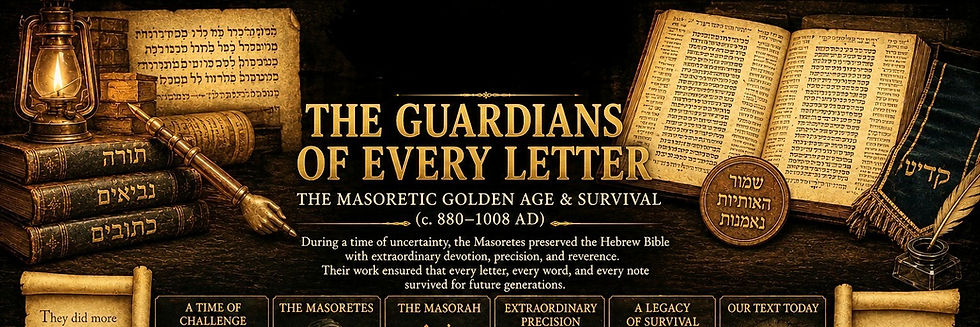
THE MASORETIC GOLDEN AGE & SURVIVAL (c. 880–1008 AD) More than four centuries after the great Greek codices were created, the story of Scripture had entered a different world. Across Jewish communities of the medieval Middle East, generations of scribes were working to preserve the Hebrew Bible with extraordinary precision. The Masoretic tradition developed systems of vowel markings, accents, spelling conventions, and detailed notes designed to safeguard the biblical text as it passed from one generation to the next. The Bible was no longer simply being copied. Its scribes were carefully preserving how every word was written, pronounced, read, and transmitted. During this extraordinary period, the ancient scroll tradition increasingly appeared alongside the bound codex. And within these manuscripts, even the arrangement of letters, words, spaces, and poetic passages could carry significance. Three remarkable Hebrew manuscripts bring this era to life.
CODEX SASSOON (c. 880–960 AD) More than a thousand years after its creation, Codex Sassoon suddenly became one of the most valuable books ever sold. On May 17, 2023, the manuscript crossed the auction block at Sotheby's in New York. When the hammer fell, it sold for $38.126 million, setting a world auction record for a book. But its true importance is far older than its price. Dating to approximately the late 9th or early 10th century, Codex Sassoon is the earliest known surviving nearly complete Hebrew Bible, with only a small number of leaves missing. Its pages preserve the extraordinary work of the Masoretic scribal tradition. Hebrew consonants, vowel markings, accents, and Masoretic notes demonstrate generations of careful textual transmission. And sometimes, even the spaces between the words matter. In biblical poetry such as the Song of the Sea in Exodus 15, traditional scribal layouts create carefully controlled blocks and spaces. This distinctive pattern, known in Jewish scribal tradition as ariach al gabei leveinah, resembles bricks arranged in alternating rows. The page itself becomes part of the transmission. The visual arrangement helps preserve traditional forms of biblical poetry alongside the words themselves. Codex Sassoon also represents a major transition in the physical history of the Hebrew Bible: ancient Jewish Scripture had long been transmitted in scrolls, while medieval scribes increasingly produced biblical texts in codex form, the ancestor of the modern bound book. Its survival is remarkable. For more than a thousand years, it passed through the hands of scribes, scholars, collectors, and communities. Then, in 2023, the world was reminded of its extraordinary significance when it sold for $38.1 million and was purchased on behalf of ANU—Museum of the Jewish People. Its monetary value made headlines. But its real value lies in what it preserves: A physical witness to generations of scribes who believed that every letter—and sometimes every space—mattered.
THE ALEPPO CODEX (c. 920 AD) For nearly a thousand years, another Hebrew Bible manuscript traveled through some of the most turbulent chapters of Jewish history. It was studied by scholars, protected by communities, threatened by violence, hidden, rescued, and eventually carried across international borders. This is the Aleppo Codex. Created in the 10th century, the manuscript became one of the most authoritative surviving witnesses to the Masoretic tradition of the Hebrew Bible. Its precision in spelling, vocalization, accents, and Masoretic notes made it an extraordinarily important model for generations of Jewish scholarship. Its connection to Maimonides adds another remarkable chapter. The great Jewish scholar consulted the manuscript in Egypt and regarded it as an exceptionally reliable model of the Hebrew biblical text. Eventually, the codex reached Aleppo, Syria, where it was protected by the Jewish community for centuries. Then came December 1947. Violence erupted in Aleppo following the United Nations partition decision. The ancient synagogue where the manuscript had been guarded was attacked and burned. For a time, the codex appeared to have disappeared. But it had survived. Members of the community rescued what remained and concealed it. Years later, portions of the manuscript were secretly carried out of Syria and eventually brought to Israel. One traditional account identifies Mordechai Faham as the courier who concealed the manuscript inside a washing machine while transporting it out of Syria toward Turkey. The account survives in community histories, although details of the journey have been debated. By 1958, the surviving manuscript had reached Jerusalem and was placed in the care of Israeli President Yitzhak Ben-Zvi and the Ben-Zvi Institute. Then came the devastating mystery. The original codex is estimated to have contained approximately 487 leaves. Only about 294–295 survive today. Most of the missing material comes from the beginning of the manuscript, including almost the entire Torah. Only the final eleven leaves of the Pentateuch survived. For decades, the simplest explanation was that the missing pages had been destroyed in the 1947 fire. But the evidence is more complicated. Some witnesses reported seeing the codex after the fire, leaving open the possibility that portions disappeared before, during, or after the manuscript's removal from Aleppo. Even more remarkable, fragments have resurfaced. In 2007, a fragment from Exodus that had survived the destruction was returned to the collection after decades in private possession. Today, the surviving Aleppo Codex is preserved in Jerusalem at the Shrine of the Book, part of the Israel Museum. It remains both a masterpiece of preservation and an unfinished mystery. A thousand years of scholarship survived. A community risked everything to save it. And somewhere within the missing pages may still be another chapter waiting to be found.
CODEX LENINGRADENSIS (1008–1009 AD) By the beginning of the 11th century, the Masoretic tradition had produced another extraordinary survivor. The Leningrad Codex, also known as Codex Leningradensis, was completed in Cairo in AD 1008–1009. It is the oldest surviving complete, dated manuscript of the Hebrew Bible. The manuscript was copied by the scribe Samuel ben Jacob for a patron named Mevorah ben Joseph. It consists of 491 parchment folios and is preserved today in the National Library of Russia in St. Petersburg. Its importance lies not simply in its age, but in its completeness. Unlike the Aleppo Codex, which suffered enormous losses during its modern history, the Leningrad Codex survived intact. Its pages preserve the Masoretic tradition, including the Hebrew consonantal text together with vowel signs, cantillation marks, and Masoretic notes. These tiny marks surrounding the Hebrew letters represent generations of scholarship devoted to protecting pronunciation, chanting, spelling, and textual tradition. The manuscript also contains beautifully decorated pages, including geometric designs incorporating biblical passages and blessings, demonstrating that rigorous textual scholarship and artistic craftsmanship could exist together within one medieval Bible. Its later journey is equally remarkable. The manuscript eventually entered the collection of Abraham Firkovich, and the National Library of Russia records its acquisition with the First Firkovich Collection in 1863. Its influence would eventually reach modern biblical scholarship. The Leningrad Codex became one of the principal manuscript foundations for major scholarly editions of the Hebrew Bible, including the Biblia Hebraica Stuttgartensia and later critical work. That does not mean modern English Old Testament translations are simply translations of this one manuscript. Scholars compare numerous manuscripts, ancient translations, and other textual witnesses. But the significance of the Leningrad Codex remains extraordinary. A Bible copied by hand in Cairo more than a thousand years ago survived complete—and became one of the principal lenses through which modern scholarship studies the Hebrew biblical tradition. THE GUARDIANS OF THE TEXT Three manuscripts. Three remarkable survival stories. Codex Sassoon reveals the extraordinary precision and visual tradition of medieval Hebrew scribal culture. The Aleppo Codex carries the story through scholarship, persecution, fire, concealment, and the mystery of its missing leaves. Codex Leningradensis brings the era to its culmination—a complete, dated Hebrew Bible that would eventually become one of the most important reference manuscripts in modern scholarship. Together, they reveal a different kind of preservation. Not the monumental Greek codices of late antiquity, but a tradition in which every letter, every vowel, every accent, and even carefully preserved spaces could matter. The Hebrew Bible had crossed another thousand years. But the world was about to change again. The age of the handwritten Bible was approaching its final great chapter. The printing press was coming. Preserving History • Inspiring Faith • Connecting Generations. — Ages of Scripture 🕊️
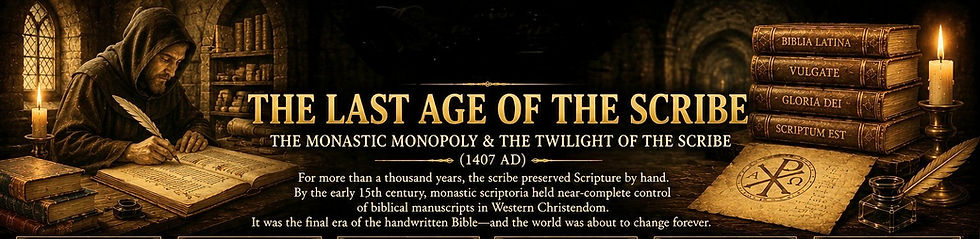

THE MONASTIC MONOPOLY & THE TWILIGHT OF THE SCRIBE (1407 AD) For more than a thousand years, the Bible had been a handwritten treasure. Before printing, every copy depended upon human hands. Parchment had to be prepared, pages ruled, letters carefully formed, and mistakes corrected one line at a time. A monumental Bible could require an extraordinary investment of time, skill, and materials. By the early 15th century, Europe was approaching the end of this great manuscript tradition. Monasteries remained important centers of learning and book production, while professional scribes and illuminators continued creating magnificent biblical manuscripts. But the world was changing. New technologies were beginning to appear, and within only a few decades, the invention of movable-type printing would transform how books were produced. The Malmesbury Bible, created in 1407, gives us a remarkable glimpse into this final age before the printing revolution.
THE MALMESBURY BIBLE (1407 AD) THE SCRIBE'S DEVOTION AND THE CHAINED TREASURE In the year 1407, more than half a century before Gutenberg's press transformed European bookmaking, a monumental Latin Bible was being created entirely by hand. Its pages were written on parchment, its letters formed individually with ink, and its decorative initials painted by hand. This was the Malmesbury Bible. The Bible was written in Belgium by the scribe Gerard Brils, with provenance connecting it to the Carthusian monastery at Herne, near Brussels. It was created for the monastery's use, including the reading of Scripture aloud to the community. To create a Bible of this scale before printing existed was an extraordinary undertaking. Every page had to be prepared by hand. The parchment had to be produced and trimmed. The writing area had to be carefully ruled. The Latin text had to be copied line by line. A mistake was not something that could simply be erased and replaced. The manuscript itself was the product of human labor. THE HAND OF GERARD BRILS: The surviving pages preserve the distinctive handwriting of the scribe who created the manuscript. One surviving page contains text from the Book of Numbers, written in Latin in 1407. More than six centuries later, the ink still preserves the physical handwriting of the person who placed those words onto parchment. THE ILLUMINATED INITIAL: The manuscript's decoration reveals another dimension of medieval bookmaking. A surviving page contains a magnificent decorated capital P, beginning the Latin word Petrus. It is more than an enlarged letter. It is a carefully painted work of art incorporated directly into the biblical text. FOUR MONUMENTAL VOLUMES: Historical cataloguing describes the Bible as a large-format manuscript in four volumes, written on vellum and containing decorated initials and miniatures. Its enormous physical scale reveals just how different this Bible was from the smaller, more portable books that would become increasingly common after printing. And there is another part of the story that requires care. The familiar image of medieval Bibles being chained to desks or lecterns is historically real in some libraries and institutions. But we should not claim that this particular Bible was definitely chained unless documentary evidence establishes it. What we can establish is more remarkable: This was a monumental Bible created at a time when every page still depended upon the hand of a human scribe. Eventually, the manuscript became associated with Malmesbury Abbey in Wiltshire, England, giving the Bible the name by which it is known today. Its pages have since been professionally digitized, allowing researchers to examine thousands of high-resolution images without repeatedly handling the fragile original. Gerard Brils could never have known what was coming. Within his lifetime, the handwritten Bible still represented the pinnacle of book production. But only a few decades later, another man in Mainz would begin experimenting with a machine capable of reproducing text again and again. The age of the scribe was approaching its twilight. The age of the press was about to begin. THE FINAL HANDWRITTEN CHAPTER The Malmesbury Bible stands at a fascinating crossroads. Behind it lies more than a thousand years of handwritten biblical tradition. Ahead lies the printing revolution. In 1407, Scripture was still being brought into the world one page at a time. The scribe ruled the parchment. The illuminator painted the page. The monastery preserved the book. But the next great revolution would change everything. THE QUILL WAS ABOUT TO MEET THE PRESS. Preserving History • Inspiring Faith • Connecting Generations. — Ages of Scripture 🕊️

THE EARLY PRINTING PRESS & CONTRABAND REVOLUTION (c. 1455–1535 AD) For centuries, producing a Bible meant copying it by hand. Then everything changed. In the middle of the 15th century, movable-type printing introduced an entirely new possibility: the same text could be reproduced again and again without every copy having to be written by a scribe. The first great printed Bibles were still shaped by the manuscript world that came before them. Their typography imitated handwritten books, their pages were often decorated by hand, and their production still required enormous skill and expense. But the fundamental difference was revolutionary. A Bible could now be reproduced. As printing spread across Europe, another revolution followed. The Bible began moving beyond Latin. English translators started bringing Scripture into the language of ordinary readers—and that transformation would prove far more dangerous than the invention of the press itself. This era takes us from Gutenberg's mechanical breakthrough to Tyndale's forbidden English and finally to Coverdale's first complete printed English Bible. The press had opened the door. The English Bible was about to walk through it.
THE GUTENBERG BIBLE (c. 1455 AD) THE INVENTOR'S SECRET AND THE END OF THE MONASTIC QUILL In the early 1450s, deep within the German city of Mainz, a goldsmith and craftsman named Johannes Gutenberg was attempting something that would transform the history of the written word. He was not merely trying to make a better book. He was developing a new way to reproduce text. The result would become one of the most famous books ever produced: The Gutenberg Bible. Printed in Mainz between approximately 1452 and 1455, the 42-line Bible was produced in roughly 180 copies, about 150 on paper and approximately 30 on parchment. Before movable-type printing transformed Europe, producing a Bible required enormous amounts of skilled labor. Gutenberg changed the equation. Individual pieces of metal type could be arranged, inked, pressed onto paper or parchment, removed, and reused. But Gutenberg faced an extraordinary challenge. His printed Bible had to compete visually with the magnificent handwritten manuscripts that preceded it. And he succeeded. THE 42-LINE REVOLUTION: The Gutenberg Bible takes its name from its characteristic 42 lines of text per column in most of the Bible. Produced in two volumes, it contains more than 1,200 pages and was carefully designed to resemble the dense Gothic manuscript writing familiar to medieval readers. THE 290 CHARACTERS: Gutenberg's workshop did not simply create one alphabet and begin printing. Approximately 290 different characters and typographic forms were created for the Bible, allowing the printed text to reproduce the visual complexity of handwritten Gothic script. THE COLORS CAME LATER: The press primarily produced the printed black text. Colored initials, headings, and decorative elements were added afterward by hand by rubricators and illuminators. This meant that individual Gutenberg Bibles could develop their own unique appearance. Printing had not eliminated craftsmanship. It had combined mechanical reproduction with human artistry. And then came the financial struggle. Gutenberg's operation required enormous investment. His associate Johann Fust provided substantial financing, and their business relationship eventually collapsed into litigation. The surviving legal record shows that the dispute became a devastating turning point in Gutenberg's career. Yet the technology he helped establish could not be stopped. Approximately 180 copies of the Gutenberg Bible were produced, and only a portion survive today. Gutenberg did not single-handedly invent every element of printing, nor did his Bible instantly create mass literacy. But his achievement helped establish a technology that would radically accelerate the reproduction and circulation of written information. For centuries, one handwritten Bible could represent years of human labor. Now the same text could be reproduced again and again. The monk's quill had not disappeared overnight. But its monopoly was over.
THE TYNDALE BIBLE (1526–1534 AD) THE SMUGGLED WORD AND THE KING'S FIRES In the 1520s, an English Bible could be more dangerous than a weapon. William Tyndale believed that ordinary English men and women should be able to read the Scriptures in their own language. That conviction placed him directly against powerful authorities who opposed unauthorized English translations. Tyndale left England and eventually established himself on the European continent, where he devoted himself to translating the New Testament from the original Greek. In 1526, his English New Testament was printed at Worms in the German lands of the Holy Roman Empire. The little book was revolutionary. Unlike the enormous manuscript Bibles of the medieval world, Tyndale's New Testament was relatively small and portable. It could be concealed. It could be transported. And it could cross borders. Most importantly, Tyndale was translating directly from the Greek New Testament. His English would eventually influence generations of English Bibles, including the King James Bible. THE POCKET NEW TESTAMENT: Tyndale's early New Testament editions were small enough to be carried discreetly. That portability became an important part of their story as copies made their way into England despite official opposition. THE LANGUAGE OF TYNDALE: Tyndale's English became deeply embedded in the language of later English Bibles. His influence can be traced through later editions including the Great Bible, the Bishops' Bible, and ultimately the King James Bible. He was not simply translating words. He was helping establish a vocabulary that would shape English Christianity for centuries. THE BATTLE OVER THE PRINTED PAGE: Authorities attempted to suppress Tyndale's New Testament. Copies were seized and burned, and surviving records document legal action against people involved with receiving and distributing the translation. The printed page had become a battlefield. Tyndale continued working. He revised his New Testament and translated substantial portions of the Old Testament from Hebrew. But he never completed the entire Bible. In 1535, he was arrested near Brussels and imprisoned. In 1536, William Tyndale was executed near Vilvoorde. His life ended. His translation did not. His words continued to circulate. Later English Bibles repeatedly drew upon his work. The exact percentage of the King James New Testament that derives from Tyndale varies according to how scholars measure textual dependence, but the larger truth is unmistakable: Tyndale's English survived him. The man was executed. The translation lived. The authorities could burn individual copies. They could not burn the language that had already entered the minds and memories of English readers. The fire consumed paper. It could not consume the words.
THE COVERDALE BIBLE (1535 AD) THE MISSING PIECES AND THE FIRST COMPLETE ENGLISH BIBLE By the middle of the 1530s, the English Bible was still unfinished. William Tyndale had accomplished something extraordinary. His New Testament had brought the Greek Scriptures into English, and he had translated substantial portions of the Old Testament. But his work remained incomplete. Then another scholar stepped forward. His name was Myles Coverdale. Working on the European continent, Coverdale assembled existing English biblical work with material from German and Latin translations, producing something that had never before appeared in print: a complete Bible in English. The first edition appeared in 1535, probably in the Low Countries. It contained the Old Testament, the Apocrypha, and the New Testament, making it the first complete printed Bible in English. Coverdale's achievement was not simply a matter of finishing someone else's unfinished work. He made editorial decisions about how the various sources should be combined, how the books should be arranged, and how the English should read. And one of his most important decisions concerned the Apocrypha. THE APOCRYPHA: Coverdale placed the Apocryphal books in a distinct section between the Old and New Testaments. This became an important feature in the history of English Bible printing. THE NEW TESTAMENT: Much of the New Testament drew upon Tyndale's earlier English translation. Coverdale therefore helped preserve Tyndale's English while incorporating it into a complete Bible. THE NEW TESTAMENT TITLE: The printed pages introduce the New Testament with the heading: "The newe Testament of our sauiour Iesus Christ" The typography and decorated initials reveal a fascinating transition between medieval manuscript aesthetics and the increasingly sophisticated world of Renaissance printing. A BIBLE DEDICATED TO A KING: Coverdale dedicated the 1535 Bible to King Henry VIII and Queen Anne. The dedication was more than a formality. It was a careful political calculation during one of the most unstable periods of the English Reformation. Coverdale's Bible did not immediately become the dominant English Bible. But its importance was enormous. It demonstrated that a complete English Bible could be printed and circulated. Only two years later, in 1537, the Matthew Bible, associated with John Rogers under the pseudonym "Thomas Matthew," combined Tyndale's work with Coverdale's and received royal licensing. And Coverdale himself would soon return to the center of the story. In 1539, he helped prepare the Bible that would become the Great Bible, the first English Bible officially authorized for widespread use in England's churches. Tyndale had begun the work. Coverdale brought together the pieces. And the English Bible had finally become whole in print. FROM MACHINE TO MOVEMENT The printing press changed how books could be made. Tyndale changed what the English Bible could say. Coverdale demonstrated that the complete Bible could exist in English in printed form. The transformation had begun with metal type in Mainz. It had moved through forbidden English New Testaments. And now a complete English Bible stood in print. But the English Bible was about to enter a far more dangerous arena. The Crown was preparing to take control of it. And the next chapter would bring us to the Matthew Bible, the Great Bible, the Geneva Bible, the Bishops' Bible, and eventually the King James Bible. The press had started the revolution. Now the state would enter the story. Preserving History • Inspiring Faith • Connecting Generations. — Ages of Scripture 🕊️

THE ERA OF STATE-SANCTIONED ENGLISH BIBLES (1537–1611 AD) By the late 1530s, the English Bible had crossed a remarkable boundary. Only a few years earlier, unauthorized English Scripture could bring imprisonment, persecution, and even death. Now the English Bible was increasingly being welcomed into the official religious life of England. But this new freedom came with a powerful condition: the Crown wanted a voice in the Bible's place within the nation. During the reigns of Henry VIII, Edward VI, Mary I, and Elizabeth I, English Bibles became deeply connected to the religious and political struggles of the English Reformation. Some were authorized by the Crown, some were produced by refugees in exile, some were designed for churches, and others were created for private study. And each left something behind. The Matthew Bible preserved much of Tyndale's English under a royal license. The Great Bible brought enormous English Bibles into parish churches. The Geneva Bible placed Scripture, study notes, and political questions directly into the hands of ordinary readers. The Bishops' Bible attempted to provide the established Church with a powerful alternative. And finally, in 1611, the King James Bible brought together nearly a century of English translation history. This was no longer simply the story of printing. It was the story of who controlled the English Bible.
THE MATTHEW BIBLE. (1537 AD) THE KING'S LICENSE AND THE MARTYR'S GHOST In 1537, an enormous English Bible appeared in print carrying words that would have been almost unimaginable only a few years earlier: "Set forth with the Kinges most gracyous lycence." The English Bible—once treated as dangerous and unauthorized—had now received the official license of King Henry VIII. But beneath the name printed on its title page was a far more complicated story. This was the Matthew Bible, published under the name Thomas Matthew. Behind that name stood John Rogers, a close associate of William Tyndale. Rogers gathered together the English biblical work that Tyndale had already completed, including his New Testament and substantial portions of his Old Testament work. Where Tyndale's translation was incomplete, Rogers incorporated material from Myles Coverdale's 1535 Bible. The result was one of the most important links in the chain that would eventually lead to the Great Bible and, generations later, the King James Bible. THE NAME "THOMAS MATTHEW": Rogers published the Bible under the pseudonym Thomas Matthew. The name helped distance the printed volume from the controversial Tyndale, whose biblical work had been condemned by English authorities. The disguise eventually became permanently attached to the Bible itself, and the Matthew Bible had been born. THE KING'S LICENSE: Printed prominently on the title page was the statement: "Set forth with the Kinges most gracyous lycence." A Bible carrying royal authorization represented a remarkable change. Only years earlier, Tyndale's English Scripture had been treated as a dangerous and unauthorized work. Now much of that same English tradition appeared under the authority of the king. TYNDALE'S VOICE BETWEEN THE COVERS: Much of the biblical text came directly from Tyndale's translation. His New Testament and Old Testament work through 2 Chronicles formed a major part of the foundation, while Coverdale supplied the remaining portions. Tyndale's name could be hidden, but his words could not. The political circumstances surrounding the Bible's license were extraordinary. Thomas Cromwell played an important role in securing official approval, following a request associated with Archbishop Thomas Cranmer. Once licensed, the Bible could be promoted for use in English churches. The irony of history would become even greater. William Tyndale was executed in 1536. Yet the English words he had labored over in exile were now appearing inside a Bible carrying the king's own authorization. And John Rogers, the man who helped preserve Tyndale's work in the Matthew Bible, would eventually face the same deadly religious and political forces. After Queen Mary I came to the throne, Rogers was condemned for heresy and burned at Smithfield in 1555, becoming the first Protestant martyr executed during Mary's reign. But the book survived, and its influence continued. The Matthew Bible became an important foundation for the Great Bible of 1539, helping move Tyndale's English into an officially sanctioned national Bible tradition. A Bible carrying the king's license contained the work of a translator who had died because of the very cause that Bible represented.
THE GREAT BIBLE (1539 AD) THE CHAINED GIANT AND THE KING'S COMMAND By the late 1530s, the English Bible had moved from the margins of English society into the very center of the nation's religious life. King Henry VIII had broken with Rome, the monasteries were being dissolved, and the English Crown was increasingly determined to establish its own authority over the Church of England. Into this turbulent world came a Bible unlike the small volumes that could be carried secretly in a coat. It was enormous, it was designed to be seen, and it was meant to be heard. This was the Great Bible of 1539. Prepared by Myles Coverdale under the direction of Thomas Cromwell, the Great Bible was a revision of the Matthew Bible and drew heavily upon the earlier work of William Tyndale. It was printed in a large folio format specifically suited to public reading in churches. THE BIBLE FOR THE CHURCH: In 1538, Cromwell's injunctions directed English churches to provide a Bible of the largest volume and place it somewhere convenient where parishioners could come and read it. The Bible was no longer simply a private luxury. It had become a highly visible part of parish life. THE ROYAL TITLE PAGE: The magnificent title page presents Henry VIII distributing the Word of God through the leaders of the English church and government. Henry is shown handing Bibles to Thomas Cranmer and Thomas Cromwell, who in turn pass them onward. The imagery makes the political significance unmistakable. The English Bible was now operating within the authority of the Crown. THE TYNDALE LEGACY: Although Tyndale had been executed in 1536, his translation continued to live inside the English Bible tradition. Coverdale's Great Bible revised and incorporated much of the earlier English biblical work, carrying Tyndale's language forward into an officially sanctioned edition. The physical character of the Great Bible tells its own story. These were not pocket Bibles. They were large, imposing volumes intended for the lectern, where Scripture could be read aloud to an entire congregation. And that is where the famous tradition of the "chained Bible" enters the story. Large Bibles placed in churches were valuable objects. In an age when books remained expensive and relatively scarce, securing important books against theft was a practical concern. Some institutional Bibles were indeed chained to desks, lecterns, or other fixtures. But we should not assume that every surviving Great Bible was itself chained. The larger historical point is what matters. The Bible had moved from something authorities once tried to suppress into something the government itself was ordering churches to display. The forbidden book had become the public book, and the English Bible had entered a completely new age.
THE GENEVA BIBLE (1560 AD) THE DANGEROUS MARGINS AND THE PILGRIMS' CONTRABAND In 1560, a new kind of English Bible emerged from the printing presses of Geneva, Switzerland. It was smaller, more readable, richly illustrated, filled with maps and study material—and designed not merely to be heard from a church lectern, but to be read and studied by ordinary people in their homes. This was the Geneva Bible. Produced by English-speaking Protestant exiles who had fled the religious persecution of Queen Mary's reign, the Geneva Bible became one of the most influential English Bibles of the Reformation era. Its significance went far beyond its translation. The Geneva Bible transformed the architecture of the Bible itself. THE NUMBERED VERSES: The 1560 Geneva Bible was the first English Bible to contain a complete system of numbered verse divisions. Verse numbering had already been developed for portions of biblical texts, but Geneva brought the system into the English Bible as a complete reading and reference system. THE STUDY BIBLE REVOLUTION: The Geneva Bible was designed as a study Bible. Its pages could contain marginal notes, illustrations, maps, summaries, tables, indexes, and other study aids. It wasn't simply presenting the biblical text. It was helping readers understand and navigate it. THE EXPLOSIVE MARGINS: And then there were the notes. Some Geneva annotations reflected the Reformed theology of their translators and contained political implications that could be uncomfortable—even threatening—to monarchs and church authorities. King James I famously objected to the notes, describing them as "partial, untrue, seditious." The marginal notes became one of the most controversial features of the Geneva Bible. They raised a question that extended beyond theology: what happens when earthly authority conflicts with God's authority? The Bible had become a book of study, but its margins had also become a place where political ideas could live. 🖼️
THE BISHOPS' BIBLE (1568 AD) THE QUEEN'S COMMAND AND THE BATTLE FOR THE PULPIT By the middle of Elizabeth I's reign, England possessed two very different English Bible traditions. The Great Bible had served the Church of England. The Geneva Bible had become enormously popular among families, scholars, and English Protestants. But the Elizabethan Church wanted something of its own. Something authoritative, something magnificent, something that could stand at the center of England's official religious life. The man who took up the challenge was Matthew Parker, Archbishop of Canterbury. The result was the Bishops' Bible, first printed in 1568. Parker did not personally translate every page. Instead, he divided the biblical text among a group of bishops and scholars, who revised the existing English tradition. The project was largely a revision of the Great Bible, while drawing upon other English translations where appropriate. The result was enormous and visually spectacular. A BIBLE FIT FOR THE ELIZABETHAN CHURCH: The first edition was a massive folio. It contained elaborate woodcuts, decorative initials, maps, coats of arms, and portraits of important Elizabethan figures. Its physical grandeur was part of its message. This was meant to be an authoritative Bible for the established Church. THE GENEALOGIES AND VISUAL WORLD: The Bishops' Bible contained extensive visual and explanatory material. Its opening genealogical diagrams drew upon medieval traditions and demonstrated Parker's deep interest in the history of the English Church and the Christian past. THE PSALMS: The pages of the Psalms reveal the characteristic typography and monumental initials of the edition. The large decorated capitals and carefully organized page design transformed the Bible into something intended to command attention when read publicly. But there was a problem. People loved the Geneva Bible. Geneva was smaller, more portable, more affordable, and packed with study notes. It had become particularly valuable for private reading and study. The Bishops' Bible never achieved the popularity of Geneva among ordinary readers. So the contest was not simply "Geneva versus Bishops." It was a contest between different visions of what an English Bible should be. The Geneva Bible emphasized private study, notes, explanation, and accessibility. The Bishops' Bible emphasized official church use, episcopal authority, grandeur, and public worship. And history would eventually bring these traditions together. When King James I commissioned a new English Bible in the early 17th century, his translators were instructed to use the Bishops' Bible as their base text while consulting earlier English translations—including Tyndale, Matthew, Coverdale, the Great Bible, and Geneva—when necessary. The Bishops' Bible was not the Bible that conquered the hearts of ordinary English families. That honor largely belonged to Geneva. But it became something else: the official bridge between the Great Bible and the King James Bible. The grand Elizabethan Bible had become the foundation upon which another Bible would be built. And that Bible was coming. 1611 was waiting.
THE KING JAMES BIBLE (1611 AD) THE CROWN'S MASTERPIECE AND THE WAR ON MARGINS In 1611, a massive Bible emerged from the London printing house of Robert Barker, the King's Printer. Its title page announced: "THE HOLY BIBLE, Conteyning the Old Testament, and the New." It would eventually become known as the King James Bible. But its story began years earlier. England already possessed several competing English Bible traditions. The Great Bible had served the Church of England. The Geneva Bible had become enormously popular among ordinary readers and Puritans. The Bishops' Bible had become the established church's official translation. King James I wanted something different. At the Hampton Court Conference of 1604, the idea of a new English Bible emerged from the religious tensions of the period. The project was intended in part to provide a translation acceptable to the established Church while avoiding the controversial political and theological character of the Geneva Bible's annotations. The work was immense. Scholars were divided into six companies working at Westminster, Oxford, and Cambridge. Forty-seven translators ultimately participated in the project. Their instructions were remarkably methodical. They were told to use the Bishops' Bible as their starting point, altering it where the original Hebrew and Greek required changes. They were also instructed to consult earlier English translations, including the work of Tyndale and others. The King James Bible was therefore not born in isolation. It was the culmination of nearly a century of English Bible translation. And when you open the 1611 edition, that history is visible. THE APOCRYPHA REMAINS: The first edition contains the Old Testament, Apocrypha, and New Testament. The Apocryphal books were positioned between the Old and New Testaments, continuing a tradition established in earlier English Bibles. THE MAGNIFICENT NEW TESTAMENT TITLE PAGE: The 1611 edition contains a spectacular engraved New Testament title page surrounded by biblical imagery, including the four Evangelists, the twelve tribes of Israel, and the twelve apostles. It was designed not merely to identify the book, but to make the opening of the New Testament a visual statement of authority. THE MARGINS WERE NOT SILENT: One of the great myths surrounding the 1611 Bible is that James completely prohibited marginal notes. He did oppose the controversial political and theological commentary characteristic of the Geneva Bible. But the translators were permitted to include notes dealing with textual and translation matters. The first edition contains thousands of such notes, including alternative readings and explanations. THE GIANT BIBLE: The 1611 edition was printed in a large format intended for public reading in churches. A single copy required hundreds of printed sheets, which had to be folded, gathered, sewn, and bound by hand. This was no pocket Bible. It was a monumental production. Then came one of the most famous printing stories in biblical history. The first edition contained typographical errors. Among the best known was the wording in Ruth 3:15, where the 1611 printing reads "he went" rather than the later corrected "she went." The subsequent resetting of the type produced what bibliographers call the "She Bible." These errors remind us of something important. The King James Bible may have become one of the most revered books in history—but its first edition was still a humanly produced printed book. Composed by scholars, set by compositors, printed on paper, corrected through later editions, and bound by hand. The translation itself was the result of years of painstaking scholarly work. The translators compared previous English Bibles, consulted Hebrew and Greek sources, debated individual words, and circulated their work among the other groups for review. When the finished Bible finally emerged in 1611, it represented something far greater than the work of a single king or a single group of translators. It was the accumulated inheritance of the English Bible tradition. Tyndale's language, Coverdale's work, the Matthew Bible, the Great Bible, the Geneva Bible, the Bishops' Bible, and generations of Hebrew and Greek scholarship all converged within its pages. The Crown commissioned it, the scholars forged it, the printers produced it, but history gave it a life far beyond what any of them could have imagined. The 1611 King James Bible would go on to become one of the most influential books ever printed, profoundly shaping English-speaking Christianity, literature, language, and culture. And that is where our chronological journey reaches its summit. From a medieval manuscript copied by hand in 1407 to Gutenberg's revolutionary press, to Tyndale's forbidden English, to Coverdale's complete Bible, to the Matthew Bible, to the Great Bible, to Geneva, to the Bishops' Bible, and finally—1611. A Bible born from centuries of manuscripts, translations, controversies, scholarship, faith, and human hands. The story was never simply about one book. It was the story of how the Bible traveled through history. THE CHRONOLOGICAL JOURNEY The manuscripts gave us the foundation. The Masoretic scribes preserved the Hebrew text. The medieval scribes carried the tradition forward. Gutenberg changed how books could be reproduced. Tyndale changed the English Bible. Coverdale completed it. The Crown authorized it. Geneva challenged authority through its margins. The Bishops' Bible prepared the way. And in 1611, centuries of history converged. The King James Bible did not appear out of nowhere. It was the culmination of a journey that had begun centuries before. Preserving History • Inspiring Faith • Connecting Generations. — Ages of Scripture